
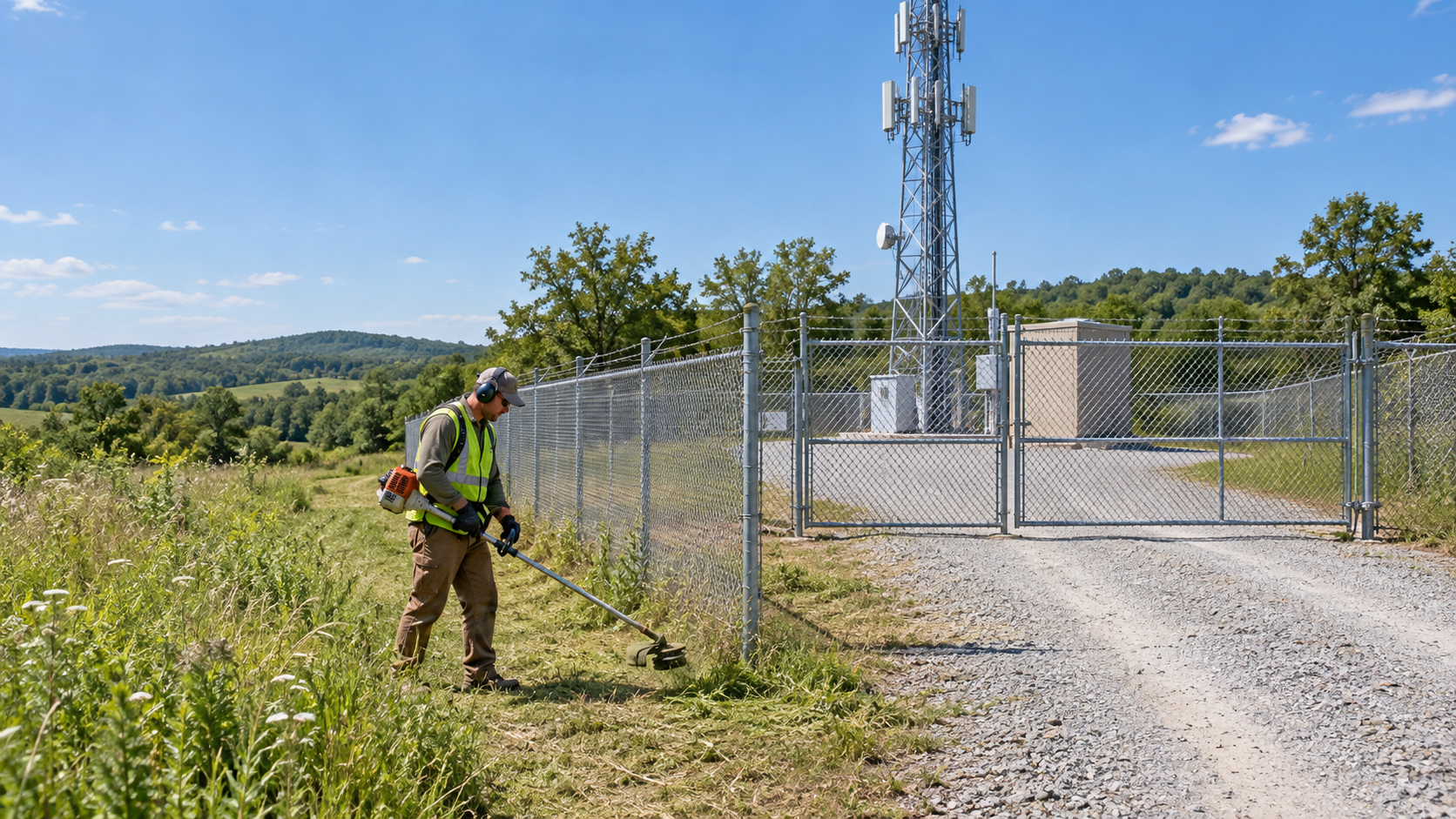
Cell tower vegetation management looks simple when viewed as mowing around a fence. Across a telecom portfolio, it becomes a site-access and service-control problem. The operator needs the compound, gate, access road, fence line and any guy-anchor areas kept reachable on a schedule that fits local growth conditions, even when the sites are spread across rural counties or several states.
The work also has to fit the site. A fenced urban compound beside a paved road does not need the same equipment or visit pattern as a guyed tower at the end of a long gravel access road. A useful vegetation program sets one portfolio standard, then records the site-level exceptions that affect access, frequency and the type of clearing required.
Cell tower vegetation management is the recurring control of grass, weeds, brush and other growth around telecom compounds, fence lines, access routes and related site areas. The purpose is to keep the site accessible and maintain a defined condition throughout the service season. Scope and frequency should be set by site layout, growth rate, access conditions and local requirements.
For telecom operators, tower owners, facilities teams and asset managers, the main question is less about how to cut vegetation and more about how to make the work repeatable across a distributed portfolio.
What vegetation management at a cell tower site involves
A tower-site vegetation scope should be built around service zones rather than a generic instruction to mow the property. The areas inside the compound, along the fence, beside the access road and around guy anchors can have different maintenance needs. Separating those zones makes the scope easier to price, inspect and adjust.
The recurring work commonly includes mowing or rough cutting, string trimming around fixed objects, controlling weeds along fence lines, cutting back brush that interferes with access, and removing obvious service debris. Where herbicide is part of the program, the contract should state where it is permitted, who is authorized to apply it and what approvals are required. The operator should avoid assuming that spraying, tree work or access-road repair is included unless the agreement says so.
| Site zone | Typical vegetation work | What to define in the scope | Common ambiguity |
|---|---|---|---|
| Inside compound | Mowing or trimming where vegetation is present; weed control around equipment areas | Service boundary, acceptable growth condition, sensitive areas | Whether bare-ground or herbicide treatment is included |
| Fence line | Trimming, weed control, brush removal | Inside and outside width; gate area; vines or woody growth | Whether the provider maintains both sides of the fence |
| Access route | Roadside mowing, brush cutback, clearance at the entrance | Road length, width to be maintained, turnarounds and drainage edges | Whether road repair or grading is a separate service |
| Guy-anchor areas | Vegetation control around anchor points and fenced anchor compounds | Exact anchor locations and required clear area | Whether these areas are part of the main compound price |
| Outer field / easement | Rough mowing or brush cutting where specified | Acreage or mapped boundary; seasonal cadence | Whether work is full mowing, bush hogging or selective clearing |
That zone-based approach also keeps this article focused on vegetation rather than broader telecom site maintenance. Fencing repairs, road reconstruction, generator work and equipment maintenance belong in a wider site-maintenance program, even though the same field provider may sometimes handle them.
Access requirements, gate keys and site-safety constraints
A crew cannot complete a vegetation visit if it cannot get through the gate or safely reach the areas in scope. Telecom sites therefore need a basic access packet that travels with the work order or route plan. At minimum, that means the correct site identifier, location, gate or lock instructions, access-road notes and an escalation contact for access problems.
The operator should also separate ordinary grounds access from controlled technical areas. OSHA’s telecommunications standard addresses hazards at telecommunications field installations, including harmful plant life, tools, electrical hazards and tree or underbrush work; other OSHA requirements may apply depending on the contractor’s work. FCC radiofrequency-exposure rules distinguish between general-population and occupational/controlled exposure conditions. The site owner’s safety program should identify any controlled areas, required training and access restrictions before a vegetation crew is dispatched.
Sources: OSHA 29 CFR 1910.268, Telecommunications (current standard, accessed 2026); FCC 19-126, RF exposure rules (2019)
For vegetation contractors, the practical rule is straightforward: site access instructions should say where the crew is allowed to work and what requires authorization or a trained escort. A mowing vendor should not have to infer RF boundaries, electrical hazards or technical access rules from signs after arriving on site.
| Access item | What the operator should document | Why it matters |
|---|---|---|
| Site identity | Site ID, address or coordinates, map pin and portfolio/market name | Prevents crews from servicing the wrong asset |
| Gate and lock | Key, code, lockbox process or contact procedure | Avoids a failed trip caused by access |
| Access road | Surface, length, steep sections, seasonal limitations and vehicle notes | Helps match vehicle and equipment to the site |
| Work boundaries | Compound, fence line, anchors, road edges and excluded technical areas | Keeps the vegetation scope separate from restricted work areas |
| Escalation | Named contact and process for locked gates, unsafe conditions or changed site conditions | Gives the crew a clear next action instead of abandoning the visit |
Gate access is a small administrative detail until a portfolio contains hundreds of sites. Then every bad code, missing key or unclear boundary becomes repeat travel, a missed cycle and another exception for the operations team to resolve.
Mowing and clearance cycles around tower compounds
A practical planning range for active-season vegetation control is roughly every 2 to 4 weeks around compounds and fence lines, with larger outer fields or rough-cut areas often running on a wider 4 to 8 week cycle. Those are planning ranges, not national standards. Growth rate, rainfall, site visibility, herbicide use, terrain and the operator’s required condition all move the schedule.
A public 2024 tower-site grass-cutting specification from the City of Suffolk, Virginia shows how one operator translated those variables into a contract. Several communications tower sites were required to receive vegetation maintenance at least every three weeks. At two guyed sites, the surrounding fields were to be mowed every five to six weeks, with an additional autumn cut to limit overgrowth before spring. The same specification required weed control along access roads, inside and outside compounds, and around guy-wire areas.
Example source: City of Suffolk IFB 25026-KR, Grass Cutting-Tower Sites (2024).
That is a useful model for specification writing because it separates the high-control areas from the broader field. A telecom operator does not need to copy Suffolk’s exact cadence. It does need to decide which site zones are allowed to grow longer and which need tighter control throughout the season.
| Site condition | Useful planning range | What can move the cycle |
|---|---|---|
| Compound and active fence line during peak growth | About every 2 to 4 weeks | Rainfall, growth rate, herbicide program, appearance and access needs |
| Outer field or rough-cut area | About every 4 to 8 weeks | Acreage, brush density, equipment access and fire/seasonal conditions |
| Dormant or slow-growth period | Reduce or pause scheduled mowing where conditions allow | Regional climate, winter weeds, access needs and contract requirements |
| Storm or rapid-growth event | Additional visit when the standard is exceeded | Downed limbs, blocked access, heavy rain and abnormal growth |
The contract should define the service trigger as well as the calendar. A fixed cycle is easy to administer, but a condition-based exception is useful when weather produces unusually fast growth or when a scheduled visit would add little value during dormancy.
Why rural and remote sites need a different service model
Remote tower sites change the economics and logistics of vegetation management. The crew may spend more time reaching the asset than working inside the compound. A failed gate code or unsuitable vehicle can turn a short mowing job into a wasted half day.
Route planning matters more in that environment. Sites should be grouped by geography, access conditions and equipment needs rather than treated as isolated work orders. A route with three nearby sites that all need a compact mower and string trimming is very different from a route that combines paved compounds with steep access roads and rough-cut fields.
Remote locations also need better exception handling. If the access road is washed out, a gate has been changed or brush has moved beyond routine mowing into heavier clearing, the crew needs a defined way to document the condition and move the issue to the right person. Repeatedly sending a standard mowing crew to a site that now requires different equipment is a service-design problem, not a crew-performance problem.
| Operating factor | Easy-access site | Rural or remote site |
|---|---|---|
| Travel | Shorter drive, easier rescheduling | Drive time can dominate the visit cost |
| Access | Paved road or simple gate access | Gravel, steep, seasonal or weather-sensitive access |
| Equipment | Standard mowing and trimming equipment | May require rough-cut equipment or different vehicle capability |
| Oversight | Closer to staff or other facilities | Little or no on-site oversight |
| Exception handling | Return visit is easier | Bad access or wrong equipment can waste a full route segment |
This is where vegetation management starts to resemble other distributed-asset programs such as utility vegetation management and right-of-way vegetation management. The physical task remains local, but route density, access information and exception control determine whether the program works at portfolio scale.
Managing vegetation across sites in multiple markets
A multi-market vegetation program should standardize the outcome without forcing the same visit count on every site. A Gulf Coast compound, a Midwestern rural tower and a dry western site can share the same service standard while running on different seasonal calendars.
The simplest structure is a portfolio baseline plus a site schedule. The baseline states what areas must remain accessible, how fence lines and gates are handled, what documentation is required and how exceptions are escalated. The site schedule records the local cadence, acreage, access notes and any zones that need different equipment or treatment.
This also helps when providers change. The operating standard stays with the portfolio instead of living inside one local contractor’s habits. New crews can see the site boundary, expected condition and local exception without rebuilding the scope from memory.
| Standardize across the portfolio | Allow to vary by site or market |
|---|---|
| Definition of serviced zones | Visit cadence |
| Expected access condition | Growing season and dormancy |
| Fence-line and gate standard | Terrain and equipment type |
| Process for access failures | Herbicide use where authorized |
| Completion documentation requirement | Outer-field or rough-cut frequency |
| Escalation and change approval | Storm and seasonal exceptions |
Broader telecom site maintenance across multiple markets deserves its own operating model because it adds repairs, security, equipment and other service categories. Detailed tower grounds cycles also deserve separate treatment. For vegetation management, the priority is to keep the service boundary, cadence and access rules clear enough that crews in different markets are working toward the same condition.
What to require from a vegetation management provider
A provider proposal should make it possible to compare coverage and operating method before comparing price. The contract needs more than a list of sites and a per-visit rate. It should explain how the provider gets in, what areas it maintains, how often it returns, what happens when the site condition changes and how completed work is recorded.
For this article, those requirements are organized as a telecom vegetation scope card: a practical checklist for turning a site list into a service specification rather than a claim that every telecom portfolio needs the same operating model.
- Site roster and mapping. List every site with a unique identifier, location and mapped service boundary.
- Access instructions. Document keys, codes, road restrictions, vehicle needs and escalation contacts.
- Service zones. Separate compound, fence line, access route, guy anchors and outer fields where applicable.
- Cycle by zone. State the expected frequency or trigger for each area, including seasonal changes.
- Equipment capability. Confirm the provider can handle the actual terrain and vegetation type, including rough-cut work where needed.
- Herbicide rules. Define whether chemical vegetation control is allowed, where it can be used and what licensing or approvals apply.
- Safety and restricted areas. Make technical or controlled areas explicit so a grounds crew does not have to infer access rules.
- Exception process. Set a workflow for locked gates, unsafe access, storm damage, overgrowth beyond scope and changed site conditions.
- Completion documentation. Define the minimum proof of visit and what site information must be reported.
- Pricing structure. Separate recurring cycles from remediation, tree work, access-road work or other out-of-scope services.
- Coverage and capacity. Confirm that the provider has a workable service model for the actual markets and travel distances involved.
- Change control. Define how new sites, deleted sites and changed frequencies are added to the program.
| Contract item | What good scope language answers | Portfolio reason |
|---|---|---|
| Access | How does the crew enter, and what happens if it cannot? | Reduces failed trips and repeat coordination |
| Boundary | Exactly what areas are included? | Prevents gaps around fences, anchors and access roads |
| Cadence | How often is each site zone serviced? | Makes seasonal differences explicit |
| Exceptions | What requires approval or different equipment? | Stops routine work from drifting into unpriced remediation |
| Documentation | What confirms the visit and records changed conditions? | Gives remote operators usable visibility |
| Coverage | How are sites grouped and staffed across markets? | Tests whether the provider can execute the portfolio, not just win the bid |
A tower vegetation program should make site access predictable
Vegetation at a telecom site is a recurring physical task, but the difficult part at scale is operational. The operator has to know which zones are maintained, when crews return, how they enter the site, what happens when conditions change and how the same standard carries across markets.
The strongest programs separate high-control areas from rough-cut areas, use a cadence that reflects local growth, and treat access failures or heavier remediation as defined exceptions. That gives facilities and asset teams a service program they can review as a portfolio rather than a collection of unrelated mowing jobs.
The contract checklist above can be used as the HiredHelpr Telecom Vegetation Scope Card, a concise way to compare site boundaries, access rules, cadence, exceptions and documentation across a distributed portfolio.
HiredHelpr provides centralized commercial property services across recurring and on-demand categories, including landscaping and grounds care. For telecom operators considering a centralized service model, coverage and service availability should be confirmed for the specific markets and site requirements involved.
Contact HiredHelpr to discuss your portfolio, service requirements and coverage needs.
Frequently Asked Questions
What is cell tower vegetation management?
Cell tower vegetation management is recurring control of grass, weeds, brush and other growth around tower compounds, fence lines, access routes and related site areas. The scope is designed to keep defined areas accessible and maintained to an agreed condition throughout the service season.
How often should vegetation be cut at a cell tower site?
A useful planning range during active growth is about every 2 to 4 weeks around compounds and fence lines, with wider 4 to 8 week cycles for some outer fields or rough-cut areas. Local climate, rainfall, growth rate, terrain and the required site condition should set the final schedule.
What areas should a tower vegetation contract include?
The contract should identify the compound, both sides of relevant fence lines, gate area, access road or entrance, guy-anchor areas where present, and any outer fields or easements in scope. Each zone should have its own maintenance expectation when the work differs.
Why are remote tower sites harder to maintain?
Remote sites add travel time, variable road conditions, locked-gate risk and equipment constraints. Because a failed visit is expensive to repeat, remote programs need accurate access information, route planning and a clear process for changed site conditions.
What should a telecom operator require from a vegetation management company?
Require a site roster, mapped service boundaries, access instructions, service cycles, equipment capability, rules for herbicide use, safety boundaries, exception handling, completion documentation, coverage capacity and a clear process for changes to the portfolio.