
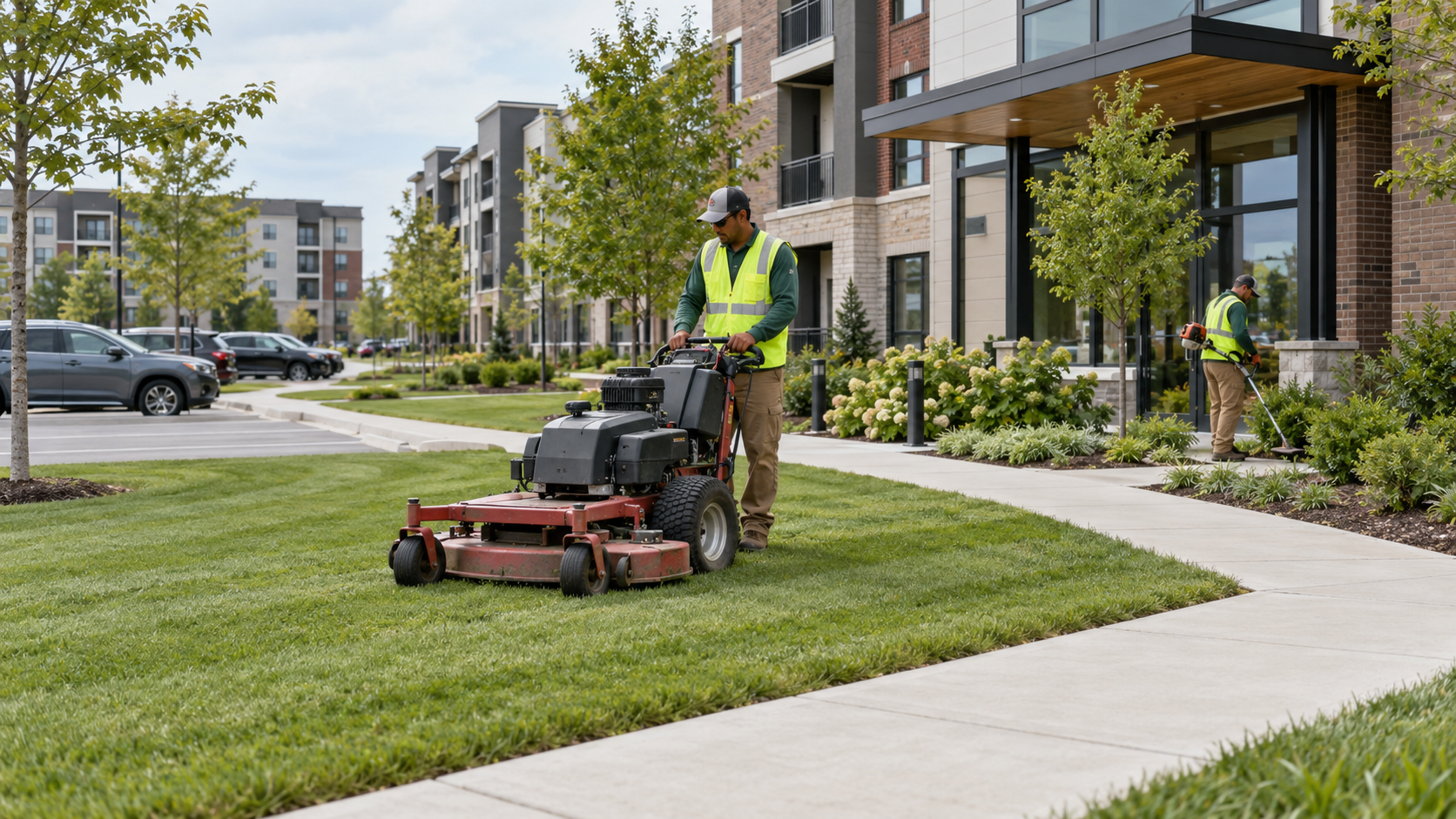
Commercial grounds maintenance is straightforward to define at one property. Across fifty, the difficulty is keeping scope, frequency and finished standard consistent when climates, layouts and local crews all differ. That makes portfolio grounds maintenance as much an operational management problem as a landscaping one.
The same service label also means different things from one provider to another. One company includes litter pickup on every visit. Another prices it separately. Seasonal cleanup, irrigation and larger pruning work create the same ambiguity.
Commercial grounds maintenance is the recurring care of a commercial property’s exterior grounds to maintain an agreed appearance, usability and service standard. It commonly covers mowing, edging, trimming, landscape-bed care, litter and debris pickup, and seasonal cleanup. The exact scope depends on the property and the service agreement.
Defining the category is only the starting point for multi-property operators: SFR and build-to-rent portfolios, multifamily operators, REITs, institutional owners, and the asset managers and facilities teams working for them. The harder task is building a standard that holds across the portfolio without forcing every property onto one schedule.
What commercial grounds maintenance covers, and what it doesn’t
A grounds maintenance scope contains several different kinds of work. Some belongs in the recurring baseline. The rest is seasonal, project-based, or requires separate approval. Those categories should be settled before the contract starts.
Recurring core maintenance is the routine baseline: mowing designated turf areas, edging along sidewalks, curbs and bed boundaries, trimming what mowing cannot reach, weed management in landscape beds, basic shrub and plant upkeep where included, litter and service-debris pickup, and cleanup of hard surfaces after the visit.
Even routine services need spelling out. Two providers will otherwise read the same scope differently.
Seasonal work is predictable but uneven across the year: leaf cleanup, seasonal cutbacks, heavier cleanup during peak growth or leaf drop, and property-specific seasonal preparation. The contract should state whether this sits inside the recurring price, runs on a seasonal schedule, or is approved separately.
Enhancements and projects change the landscape rather than maintain it: redesign, new planting, sod or turf replacement, larger mulch installations. Separating these from routine maintenance gives the operator a clean view of recurring cost against one-off improvement.
Specialized services may sit outside the grounds scope entirely or need a specialist: irrigation diagnosis and repair, major tree pruning or removal, storm cleanup, and snow and ice management.
There is no universal list that applies to every grounds maintenance company. What matters is what the agreement says.
| Service area | Common recurring scope | Often seasonal or separate | Contract question |
|---|---|---|---|
| Turf | Mowing, edging, trimming | Sod or major turf replacement | Which areas are included, and how is cadence set? |
| Landscape beds | Weed control, routine bed care | Mulch refreshes, new planting, redesign | What bed work is in the recurring price? |
| Trees and shrubs | Routine trimming where scoped | Major pruning or removal | Where does routine maintenance end? |
| Cleanup | Service debris and litter pickup | Storm or large-volume cleanup | What level of cleanup is part of each visit? |
| Irrigation | Observation where specified | Diagnosis, parts and repair | Is irrigation in the agreement at all? |
Clear categories make proposals comparable and reduce arguments about extra charges later.
The standard scope: mowing, edging, beds, litter, seasonal cleanup
Once the recurring services are settled, the next step is defining what a completed visit looks like. A task list on its own leaves too much room for interpretation.
Mowing scope should identify the turf areas serviced, the expected finished condition, and how cadence changes through the year. Where a site has several separate turf areas, the provider needs to know exactly which are included.
Edging and trimming decide whether a completed visit actually looks finished. A property can be mowed and still look rough along curbs, sidewalks, fences and signs. If those details are part of the property standard, write them into the scope rather than leaving them to crew judgment.
Landscape beds need a stated expectation for existing beds, typically weed management and basic plant upkeep. Two providers can both offer “landscape maintenance” while including very different amounts of bed work.
Litter and debris is easy to underrate next to mowing and pruning, but at retail, multifamily and other high-traffic properties it drives how the site looks between visits. Name the areas covered and the cleanliness standard expected.
Seasonal cleanup is where a standard visit can require considerably more work. State whether that sits in the normal scope, runs on a scheduled seasonal service, or is treated as additional work.
| Service | Expected standard | Common scope ambiguity |
|---|---|---|
| Mowing | Designated turf serviced to the agreed condition | Which areas, and how cadence changes |
| Edging and trimming | Borders and hard-to-reach areas finished with the visit | Whether these are included with mowing |
| Landscape beds | Existing beds kept to the agreed standard | Where upkeep ends and enhancement begins |
| Litter and debris | Defined areas left to the agreed cleanliness standard | Whether pickup is included, and where |
| Seasonal cleanup | Seasonal material handled to an agreed plan | Whether higher-volume cleanup needs approval |
The goal is that the operator and the provider are judging the same finished result.
Service frequency by property type and climate zone
There is no single national cadence, but there is a conventional starting point, and a portfolio standard should say what it is rather than leave the question open.
For most commercial turf, the convention is weekly mowing through peak growth, stretching to every ten to fourteen days in shoulder periods, and stopping or dropping to occasional cleanup visits during dormancy. Landscape beds are typically serviced on the same visit, with a deeper bed pass monthly. Seasonal cleanup concentrates into a few weeks at leaf drop. A contract that specifies “monthly landscaping” at a Gulf Coast property in July and at a Minnesota property in January is specifying two entirely different jobs.
Climate is the largest variable, and it is measurable. The USDA Plant Hardiness Zone Map divides the United States into 13 zones, each split into warmer and cooler half-zones, based on 30-year averages of the lowest annual winter temperature. The 2023 revision drew on 13,412 weather stations, up from 7,983 in the 2012 edition, and moved roughly half the country into the next warmer half-zone, a shift of up to 5°F. USDA cautions that these updates reflect improved data and the volatility of extreme minimum temperatures, and should not be read as a climate-change indicator on their own. For a multi-state portfolio, the map is a useful broad reference for regional temperature differences, but it is not a mowing calendar; actual service cadence should follow local growing conditions, turf type, seasonal weather and the property’s required standard.
Property use matters nearly as much. A high-traffic retail or mixed-use site needs closer attention at entrances, parking areas and visible beds. A multifamily or build-to-rent community carries larger resident-facing common areas and tighter appearance expectations. A remote or low-traffic property may need a lower appearance standard but more reliable proof that the visit happened.
| Factor | Why it changes service frequency |
|---|---|
| Property use | Higher-visibility and high-traffic areas need closer attention |
| Climate zone | Growing-season length and dormancy differ between markets |
| Season | Growth, leaf drop and weather change the work required |
| Landscape design | Turf-heavy sites differ from sites with extensive beds or hardscape |
| Service standard | Tighter appearance requirements need a tighter cadence |
Operators can still standardize how frequency is set. One process for setting service levels, approving seasonal changes and recording exceptions works across the portfolio even when visit counts differ by market.
What changes when you manage 5 sites vs 50
The physical work at each property barely changes as a portfolio grows. The management of it changes completely, and this is where grounds maintenance stops being a landscaping question.
With five locations, a regional manager can hold the portfolio in their head. Site A needs extra litter pickup near a busy entrance. Site B has a section excluded from mowing. Site C runs a different schedule because of local conditions. At five sites that knowledge lives in one person’s memory and works well enough. At fifty it fails.
Informal knowledge becomes documented scope. Every exception a manager remembers has to exist in writing, because the person who needs it next is in another market or another role. Undocumented exceptions are the most common source of a “we never agreed to that” dispute.
Follow-up outgrows the phone call. At five sites, a phone call fixes a problem. At fifty, issues arrive faster than any individual can chase them, and the portfolio needs named ownership, defined response times and a route for problems that the first call does not resolve.
Visual inspection becomes remote verification. A manager can walk five properties. Nobody walks fifty across six states. Confirmation that scheduled work happened has to arrive as data rather than observation. That is why completion evidence becomes a contract requirement rather than a courtesy.
Billing stops being a per-invoice job. Five invoices can be reviewed individually. Fifty vendors across multiple markets produce a reconciliation problem: cost per site, per unit and per service, plus the ability to spot repeat issues, missed visits and price drift. At that point the operator needs vendor performance measured rather than sensed: completion rate against schedule, re-service frequency, response time on reported issues, and consistency of pricing between markets. Reviewed on a set cadence, those few measures show whether a service network is holding up.
| Area | Around 5 sites | Around 50 sites |
|---|---|---|
| Vendor management | Local relationships managed individually | A repeatable qualification and review process |
| Scope | Property differences familiar to the manager | Differences documented centrally |
| Quality checks | Managers can inspect sites personally | Scalable remote verification |
| Billing | Invoices reviewed one by one | Reconciliation and spend visibility by site and service |
| Escalation | Informal calls | Named ownership and defined response times |
| Standards | Problems corrected property by property | Standards documented centrally |
The numbers are illustrative. Some five-site portfolios are complicated; some large portfolios already have strong central systems. What scales is the volume of information, vendor coordination and follow-up to be managed. This is where vendor consolidation, standardized scopes and centralized property service management earn their place. The grounds work still happens locally. Centralization changes how it is managed.
Verifying that work was actually done
Once a portfolio outgrows personal inspection, the contract has to answer a blunt question: how does the operator know a scheduled visit happened, and happened to standard?
Completion evidence. The working convention in field service is a photograph tied to a timestamp and a location, captured at the site. Photos alone prove little, because an undated image could be from any visit. Timestamp and geolocation together establish that a crew was at that property on that date. Beyond that, the operator decides how much evidence is proportionate: a small set of standard shots for each visit, before-and-after images for seasonal work, and exception-based review when evidence is missing or falls short. At portfolio scale, completion evidence can be captured for every visit even if the operator chooses to manually audit only a sample.
Missed and incomplete service. A missed visit discovered days later is not a manageable process, particularly at remote properties. The agreement should state who reports a miss, how quickly, and through what channel. It should also treat a visit that happened but fell short of the finished standard as the same class of problem, because operationally it is.
Re-service. A re-service clause should name a window in hours or days, not “promptly,” and should say who confirms the correction and whether re-service is billable. Without a stated window, every quality failure becomes a negotiation.
Exceptions. Real sites interrupt schedules. A gate is locked, weather prevents service, the crew finds work beyond the written scope, or conditions differ from the specification. Each has a correct handling: notification within a defined period, a rescheduling rule, and an approval threshold above which extra work needs authorization before it proceeds. Exceptions handled informally are how a portfolio standard quietly stops being a standard.
Specifying a consistent standard across every location
A portfolio standard needs enough detail that different properties and providers read it the same way. “Maintain landscaping” is too broad. A useful standard identifies what is serviced, what outcome is expected, and what happens when local conditions require an exception.
Write the scope around outcomes. “Mow lawn” describes an activity. A stronger scope names the designated turf areas, the expected cadence, the cleanup requirement, and what the property should look like when the visit is complete. The same applies to beds, trimming, litter and seasonal work. This does not mean a technical manual for every property. It means removing the ambiguities most likely to produce inconsistent service.
Separate portfolio standards from site exceptions. A practical model uses a portfolio-level baseline of common services and expectations, documented property or market exceptions where conditions genuinely differ, and a defined process for approving future changes. A southern property may need a different seasonal cadence from a northern one. Another site may have no turf at all. Those differences sit comfortably inside one standard as long as they are written down rather than remembered.
A minimum portfolio grounds standard should define properties and exact service areas, the recurring tasks at each property, cadence and seasonal adjustment rules, expected completed condition, site and market exceptions, documentation required after service, the process for reporting incomplete work, and approval requirements for anything outside standard scope.
Grounds maintenance vs landscaping: why the contract wording matters
“Grounds maintenance” and “landscaping” are used differently by different companies. Grounds maintenance usually emphasizes recurring exterior upkeep. Landscaping is often broader, covering routine maintenance but also design, installation, planting and improvement work. Neither label tells an operator what will actually be performed.
There are structural reasons for that vagueness. The landscaping services market is highly fragmented. NALP, citing IBISWorld, puts it at roughly $188.8 billion across some 692,777 businesses employing more than 1.4 million people in 2025. With that many independent operators, there is no shared vocabulary to inherit, and no reason to expect two proposals to define the same term the same way.
So one proposal titled “commercial landscaping” may cover mowing, bed maintenance and litter pickup. Another may include routine turf work but price seasonal cleanup separately. A third may distinguish between groundskeeping, landscape maintenance and enhancement work.
Terminology matters less than scope. Before comparing price, confirm the proposals are comparable: same properties, same serviced areas, same tasks, same frequencies, same seasonal assumptions. Otherwise two proposals that look alike on the first page cover very different amounts of work, and the cheaper recurring rate is not the cheaper contract.
What to require in a portfolio grounds contract
A grounds contract should make recurring service predictable enough to manage across a portfolio. The items below make up the HiredHelpr Portfolio Grounds Contract Standard, a vendor-neutral checklist for scoping and comparing multi-property grounds agreements.
- Properties and service areas. The locations covered and which exterior areas are included.
- Recurring services. The routine tasks included in the agreement.
- Exclusions. What falls outside recurring scope.
- Frequency. Cadence by property, service and season.
- Seasonal adjustments. How schedules or scope change through the year.
- Quality standard. The expected condition after service.
- Site exceptions. Properties or markets requiring different treatment.
- Completion documentation. What evidence confirms service, and in what form.
- Missed-service and re-service process. How incomplete work is reported and corrected, and within what window.
- Escalation contacts. Named responsibility when normal resolution is insufficient.
- Pricing structure. Recurring and separately approved work kept distinguishable.
- Change-order approval. Who authorizes work outside normal scope, and above what threshold.
- Reporting and review. How service activity and recurring issues are reviewed, and how often.
- Contract changes. How locations, services or standards are added or changed.
| Contract item | What to define | Why it matters at portfolio scale |
|---|---|---|
| Scope | Exact services and serviced areas | Reduces differing interpretations between properties |
| Frequency | Cadence by service, site and season | Keeps scheduling decisions documented |
| Exceptions | Property and regional variations | Lets one framework work across markets |
| Verification | Required completion documentation | Gives visibility into remote properties |
| Re-service | Process and window after a failure | Creates a predictable correction path |
| Change orders | Approval and pricing rules | Prevents out-of-scope work being handled informally |
| Reporting | Service activity and recurring issues | Makes portfolio-level review practical |
The same framework makes provider comparison useful. If one company includes seasonal cleanup and another treats it as additional work, the recurring price alone says nothing about which proposal costs less. Scope, frequency and exclusions have to be normalized first.
Operators should also decide how many separate service relationships they want to manage. Using local providers directly works well when a portfolio is small or concentrated in one market. As properties and markets multiply, some operators move toward a centralized or single-source model to reduce the number of vendor processes handled internally. The work still needs capable local crews. What changes is how it is coordinated, verified and reported.
Building a grounds standard that can scale
A clear scope is the foundation of commercial grounds maintenance. Across a larger portfolio, the process around that scope matters just as much: setting frequency, documenting local exceptions, confirming completion, and resolving problems when they occur. The more properties involved, the harder it becomes to rely on separate vendor relationships and knowledge held by individual property managers.
HiredHelpr provides a centralized property-services model with local service execution, so multi-property teams can manage recurring and on-demand grounds work through one service relationship.
Contact HiredHelpr to discuss your portfolio, service requirements and coverage needs.
Frequently asked questions
What is included in commercial grounds maintenance?
Commercial grounds maintenance commonly includes mowing, edging, trimming, landscape-bed upkeep, litter and debris removal, and seasonal cleanup where specified. Exact inclusions vary by contract, so operators should define the individual services rather than rely on the general service label.
How often should commercial grounds maintenance be performed?
The convention for most commercial turf is weekly mowing through peak growth, every ten to fourteen days in shoulder periods, and reduced or suspended service during dormancy. The precise calendar depends on climate zone, property type, landscape design and the required appearance standard, so multi-market portfolios should standardize the process for setting frequency while allowing different schedules by location.
What is the difference between commercial grounds maintenance and landscaping?
Grounds maintenance usually emphasizes recurring exterior upkeep. Landscaping is often used more broadly and may include design, installation and enhancement work. Because provider terminology varies, the scope of work matters more than the label.
How do you verify that grounds maintenance was actually completed?
The working convention is photographic evidence tied to a timestamp and site location, captured during the visit. At portfolio scale, completion evidence can be captured for every visit, while operators may review exceptions or audit a representative sample depending on their quality-control process. The contract should define what evidence is required, who reports a missed or incomplete visit, and the window for re-service.
How do you standardize grounds maintenance across multiple properties?
Use a portfolio-wide baseline for scope, expected outcomes, documentation and issue resolution, then record property or regional exceptions separately. This maintains one standard without forcing identical service schedules everywhere.
What should be included in a grounds maintenance contract?
A portfolio grounds contract should define service areas, recurring scope, exclusions, frequency, seasonal changes, quality standards, completion documentation, re-service procedures, escalation contacts, pricing, reporting and change-order rules.