
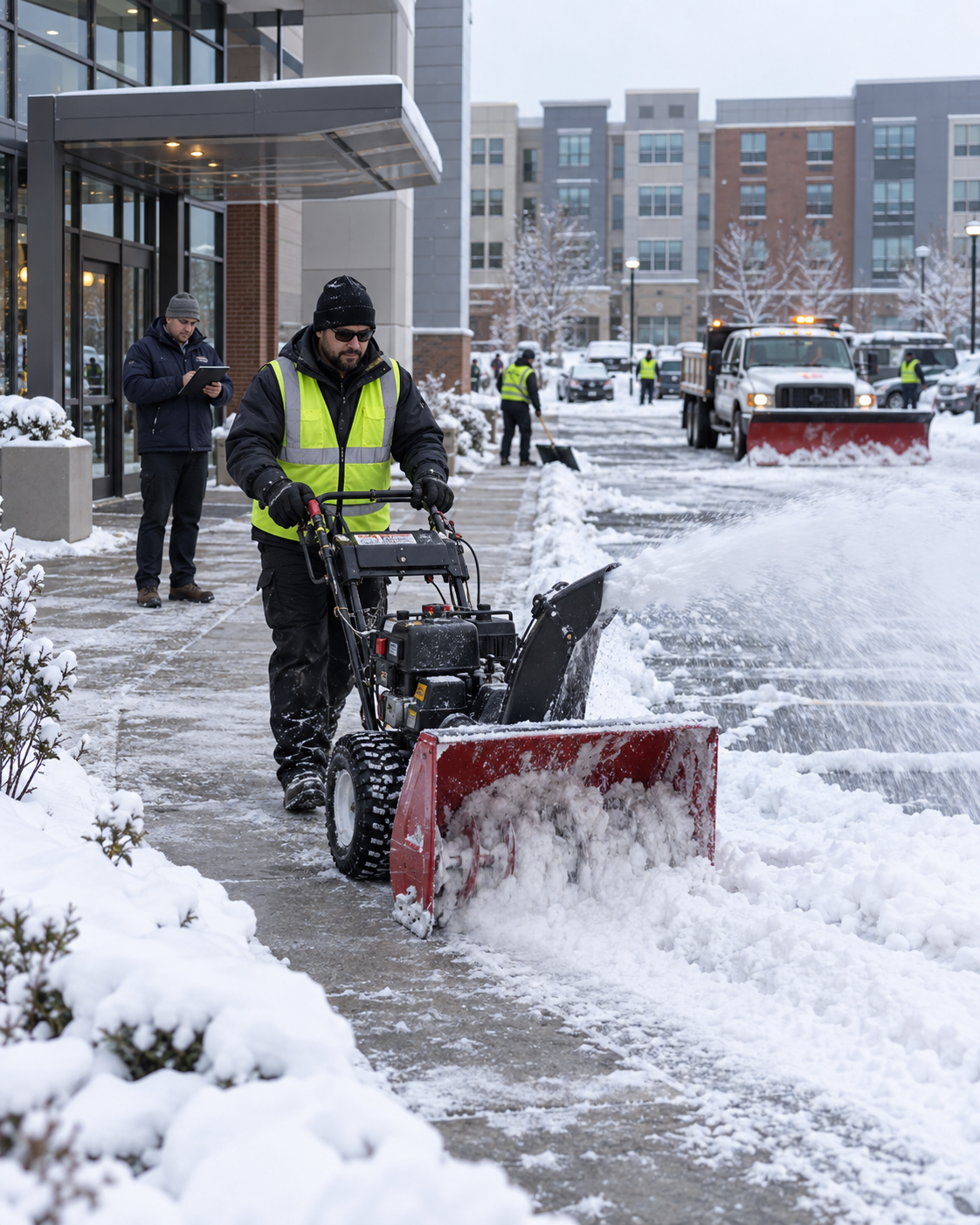
A snow forecast creates the same deadline at every property in its path. Parking lots, entrances, sidewalks, loading areas and access routes can all need attention within the same few hours. For a multi-site operator, choosing a snow provider is therefore less about finding someone with a plow and more about knowing whether the service model holds up when several locations need work at once.
That makes vendor selection different from most recurring exterior services. A landscaping visit can often move by a day without changing the operating condition of the property. Snow and ice work is tied to weather, traffic, safety expectations and narrow service windows. A provider that performs well at one site can still fail a portfolio if coverage, triggers or capacity are unclear.
Choosing a commercial snow removal company for a multi-site portfolio means testing whether the provider can execute the same service plan across every property during the same weather event. The core checks are coverage, trigger thresholds, response windows, contract structure, equipment and labor capacity, insurance, service records and escalation.
The eight checks below are designed for property managers, regional operators, facilities teams and procurement staff comparing commercial snow removal companies. The goal is to make proposals comparable before price becomes the deciding factor.
Why choosing a snow provider is different from choosing a landscaper
Snow removal is capacity-compressed work. A landscaping contractor can route a week of visits across several days. During a storm, a snow contractor may need to service dozens of client sites within the same operating window while road conditions slow travel and the weather continues to change.
The contract also has to describe event-based decisions that do not exist in the same way with routine landscaping. The operator needs to know what starts service, what areas receive plowing or deicing, whether crews return during a long event, what happens after refreeze and who decides that the property is complete.
SIMA, the Snow and Ice Management Association, treats procurement and planning as a formal part of winter service management. Its procurement standard covers contract terms, level-of-service requirements, scope of work, monitoring and documentation. That is a useful way to frame vendor selection: the provider is being hired to execute an operating plan, not simply perform a trade.
Research reference: Snow and Ice Management Association, Standards, accessed 2026. https://www.sima.org/standards
| Selection issue | Landscaping provider | Snow removal provider |
|---|---|---|
| Timing | Visits can often be routed across several days | Many sites may require service during the same storm window |
| Trigger | Recurring calendar | Weather, accumulation, ice or defined site condition |
| Capacity test | Normal weekly route | Simultaneous demand during major events |
| Service completion | Finished landscape condition | Usable areas plus defined snow and ice condition |
| Risk record | Routine service history | Event records, material use, exceptions and follow-up |
1. Coverage: can they reach every site you own?
Start with the actual property list, not the provider’s sales map. A company may describe itself as regional or national and still rely on different subcontractors, equipment pools or service partners from one market to another. What matters is whether every property in scope has a workable delivery plan before the first storm.
Ask the provider to map each site to the market, branch, crew or subcontractor responsible for it. For remote locations, include travel distance and known access constraints. For dense portfolios, ask how routes are divided when several sites in the same metro need simultaneous service.
A useful coverage review also identifies the properties that are hardest to serve. One rural retail site or mountain-market property creates more operational risk than ten locations in a dense metro. If the provider has no clear answer for the outliers, the portfolio does not have full coverage.
| Coverage question | Evidence worth asking for |
|---|---|
| Who services each property? | Site-to-market or site-to-crew assignment |
| Where are subcontractors used? | Named subcontractor model and accountability path |
| Which sites are difficult to reach? | Travel, access and storm-route notes |
| What happens if a local crew is unavailable? | Backup crew or capacity plan |
| Can the provider add sites during the term? | Defined onboarding and pricing process |
2. Trigger thresholds: at what depth do crews deploy?
A trigger threshold turns weather into an operational instruction. It needs to say when service begins, what condition is being measured and which service is triggered. A contract might use an accumulation threshold for plowing, a separate condition for sidewalks and another rule for ice treatment. The correct threshold depends on property use, local weather and the level of service the operator is buying.
Avoid a contract that mentions only snowfall depth. Freezing rain, sleet, melt-and-refreeze conditions and drifting can create a service need without meeting the plowing threshold. Snow and ice should be treated as related but separate operating conditions.
SIMA contract guidance makes the same point: contracts should identify the exact condition that creates the contractor’s duty to service a property, including the type of precipitation and any monitoring obligation after the initial event.
Research reference: SIMA, The devil is in the contract details, accessed 2026. https://resources.sima.org/snow-and-ice-resource-center/the-devil-is-in-the-contract-details
A trigger is useful only when both sides know what is being measured, where it is measured, what service it starts and whether the provider must keep monitoring after the first visit.
3. Response windows: defined and in writing
“Prompt response” is not a service level. A multi-site contract needs a clock that both sides can read the same way.
The response term should distinguish between dispatch, arrival, first pass and final completion where those stages matter. A property that must remain accessible during business hours may need ongoing passes during a long storm rather than one completion target after precipitation stops. A lower-priority site may use a wider window.
Also define what starts the clock. If the agreement says service begins within four hours, four hours after what: the trigger threshold, the end of snowfall, a property-manager request or the provider’s own weather determination? That detail can change the practical value of the promise.
For a portfolio, response levels can be tiered by site rather than negotiated one property at a time. Hospitals, 24-hour operations, multifamily entrances, retail opening routes or executive office sites may have different priorities, but the same definitions should apply across the contract.
4. Contract structure: per-event, seasonal, or hybrid
Commercial snow pricing shifts weather risk between the operator and the provider. There is no single contract model that is best for every portfolio. The useful question is which model matches the portfolio’s snowfall variability, budgeting priorities and need for dedicated capacity.
Industry procurement guidance recognizes several common structures, including per-event, per-occurrence or per-push, seasonal and time-and-materials arrangements. Hybrid models combine elements of those approaches.
Research reference: SIMA, Purchasing Snow and Ice Management Services, fee structure guidance. https://resources.sima.org/hubfs/Best%20Practices/Quality%20RFP%20Creation%20and%20Best%20Practices.pdf
| Contract model | How billing works | Where it fits | Main question to resolve |
|---|---|---|---|
| Per-event | Price for a defined storm event or event band | Operators comfortable with weather-driven spend | Exactly what defines one event? |
| Per-push / per-occurrence | Each plow, salt application or visit is billable | Sites where actual activity should drive cost | Can one storm create several billable occurrences? |
| Seasonal fixed price | Agreed seasonal amount | Budget predictability and reserved capacity | What snowfall or service assumptions sit behind the price? |
| Hybrid / tiered | Fixed component plus event, snowfall or service bands | Portfolios balancing budget stability with weather variability | How and when does pricing move between tiers? |
| Time and materials | Actual labor, equipment and materials | Irregular work, special events or remediation | What rates, minimums and approvals apply? |
Whatever model is used, compare the same service scope. A low seasonal price that excludes sidewalks, hauling, refreeze checks or ice treatment is not cheaper than a higher price that includes them. It is a different product.
5. Equipment and crew capacity in each market
The capacity question is not how many trucks the company owns. It is whether the provider has enough appropriate equipment, operators and material access to meet the contracted windows across your properties when conditions are difficult.
Ask for the operating plan by market. A large parking lot may depend on loaders or pushers. Tight urban sites, sidewalks and structured parking can need different equipment. Some properties require on-site or dedicated equipment because travel during a storm would make the response window unrealistic.
Backup capacity matters as well. Equipment fails, operators call out and major events run longer than forecast. A credible provider should be able to explain what happens when the primary plan loses a truck, a crew or access to material.
OSHA identifies winter driving, powered equipment, work-zone traffic, cold exposure and snow-removal tasks as specific worker hazards. From a property operator’s perspective, that makes safety preparation part of capacity. The right equipment is only useful if trained crews can deploy it safely in winter conditions.
Research reference: U.S. Occupational Safety and Health Administration, Winter Weather Hazards/Precautions, accessed 2026. https://www.osha.gov/winter-weather/hazards
| Capacity evidence | What it tells the operator |
|---|---|
| Equipment assigned by site or route | Whether the proposed plan matches the property footprint |
| Backup equipment and operator plan | How the provider handles failure during an event |
| Material storage or replenishment plan | Whether salt or deicer availability can support long events |
| Subcontractor capacity by market | How much execution depends on third parties |
6. Liability, insurance and slip-and-fall documentation
Snow and ice work carries a different risk profile from routine grounds maintenance because pedestrian and vehicle conditions can change during and after a storm. Insurance and contract language therefore need a more careful review than a certificate collected during vendor onboarding.
Common coverage categories in commercial snow contracts include general liability, commercial auto, workers’ compensation and employer’s liability, and umbrella or excess liability. Required limits, endorsements, additional-insured wording, indemnification and state-specific requirements should be reviewed with the operator’s insurance broker or legal counsel rather than copied from a generic template.
The operational side matters too. The contract should state who is responsible for sidewalks, entrances, accessible parking areas, loading docks and other defined zones, and whether the provider has an obligation to monitor or return for refreeze conditions. Vague responsibility creates problems long before a claim is filed.
OSHA advises employers to clear walking surfaces of snow and ice and spread deicer as quickly as possible after winter storms. That is worker-safety guidance rather than a contract standard, but it reinforces why pedestrian areas and ice treatment need explicit ownership.
7. Service records: how completion is proven
For a multi-site portfolio, a snow service record should tell someone who was not at the property what happened during the event. That record becomes useful for operations, invoice review, customer complaints and incident follow-up.
The documentation requirement does not need to turn every visit into a report-writing exercise. It does need enough structure that records from different markets can be compared and retrieved later.
| Record field | Why keep it |
|---|---|
| Property and service area | Ties the work to the correct site and scope |
| Arrival and departure time | Shows when the service occurred |
| Weather or site condition | Provides context for the work performed |
| Service performed | Separates plowing, shoveling, deicing and other work |
| Material used where relevant | Supports operational and invoice review |
| Exception or access issue | Explains incomplete areas or return visits |
| Photos or other completion evidence | Provides a visual record where the contract requires it |
Detailed proof-of-completion systems belong in the separate maintenance-verification article planned for M2. For snow-provider selection, the simpler requirement is that the provider can produce consistent event records across the sites it services.
8. Escalation: who you call when a site is missed
A missed snow visit is different from a routine maintenance delay because the property condition can worsen while the operator waits for an answer. The contract should therefore name the escalation path before winter begins.
At minimum, define the normal dispatch or account contact, the after-hours contact during active weather, the person who owns unresolved service failures and the process for portfolio-level escalation when several sites are affected at once.
The provider should also know who on the client side can change priorities, approve extra work or authorize a return visit. Without that authority map, crews and account teams can lose time waiting for someone to make a decision during the storm.
A practical escalation path has four levels: normal service contact, active-storm operations contact, management escalation for a missed or unsafe site, and portfolio escalation when the problem affects multiple properties.
Booking before the season: why timing decides availability
Snow capacity is committed before it is used. Providers assign routes, line up subcontractors, prepare equipment, secure material and decide which accounts need dedicated resources. That planning is one reason snow procurement works better before winter conditions arrive.
Booking earlier does not mean accepting the first proposal. It gives the operator time to walk sites, map priority areas, compare contract structures and resolve questions about triggers, stacking locations, sidewalks, loading zones and after-hours contacts before the first event.
Late procurement can still find a provider, but it reduces the amount of time available to test the operating plan. The risk is highest at properties that need dedicated equipment, have narrow response windows or sit outside dense service routes.
For a multi-site portfolio, the final selection meeting should focus on the difficult scenario rather than the average one. Ask what happens when several markets receive snow at the same time, one crew loses equipment and a priority property reports an incomplete pass. The answer shows more about the service model than a standard capability presentation.
HiredHelpr Multi-Site Snow Provider Scorecard: confirm coverage, triggers, response windows, contract model, market-level capacity, insurance requirements, event records and escalation. Score each item against the actual property list, not a generic company capability statement.
Choose a provider whose operating plan survives the storm
Commercial snow removal companies are easy to compare when the conversation stays at the level of trucks, hourly rates and service territory. Multi-site operators need a harder test. The provider has to show how coverage, triggers, response commitments, equipment, records and escalation work together when demand peaks across the portfolio.
That does not require every property to use the same threshold or response window. It requires one set of definitions and a documented local plan for each site. When those pieces are clear, price comparisons become more meaningful and the property team knows what to expect before weather creates the deadline.
HiredHelpr provides centralized property services across recurring and on-demand categories. For snow and ice requirements, service availability and coverage should be confirmed for the specific markets and property needs involved.
Contact HiredHelpr to discuss your portfolio, service requirements and coverage needs.
Frequently asked questions
What should I look for in a commercial snow removal company?
Look for confirmed coverage at every property, clear service triggers, written response windows, enough equipment and labor for simultaneous storms, appropriate insurance, consistent service records and a defined escalation process. Compare those items against the actual site list before comparing price.
What is a normal snow removal trigger for a commercial property?
There is no single trigger that fits every commercial property. Contracts commonly use a defined accumulation threshold for plowing and separate conditions for ice treatment. The agreement should state what is measured, where it is measured, what service the trigger starts and whether monitoring continues after the first visit.
Is seasonal or per-event snow removal better for a multi-site portfolio?
Seasonal pricing gives more budget predictability, while per-event or per-push pricing ties cost more closely to actual weather activity. Hybrid structures split the risk. The better model depends on local snowfall variability, service scope, dedicated-capacity needs and the operator’s budgeting priorities.
What documentation should a snow removal contractor provide?
A useful event record identifies the property, service time, site conditions, work performed, materials used where relevant, exceptions and any required completion evidence. The record format should be consistent across markets so portfolio teams can review service without reconstructing the event from emails and phone calls.
When should a commercial snow removal contract be signed?
The contract should be in place early enough for site walks, route planning, equipment allocation, material planning and escalation contacts to be settled before winter service is needed. Properties requiring dedicated equipment or tight response windows benefit most from earlier procurement.