
Multifamily maintenance is split between work that benefits from an onsite team and work that is easier to manage through specialist contractors. At one apartment community, that division can stay informal. Across a portfolio, it needs to be deliberate. The outsourcing model affects staffing, vendor count, budget ownership and the standard residents see from one property to another.
Landscaping is one of the clearest examples. It runs on a recurring calendar, requires its own equipment and crew capacity, and is commonly handled as a contract service. Pool operations are different. Many apartment operators keep day-to-day pool responsibility with trained onsite staff because the work is closely tied to daily inspections, water testing, resident use and local operating requirements.
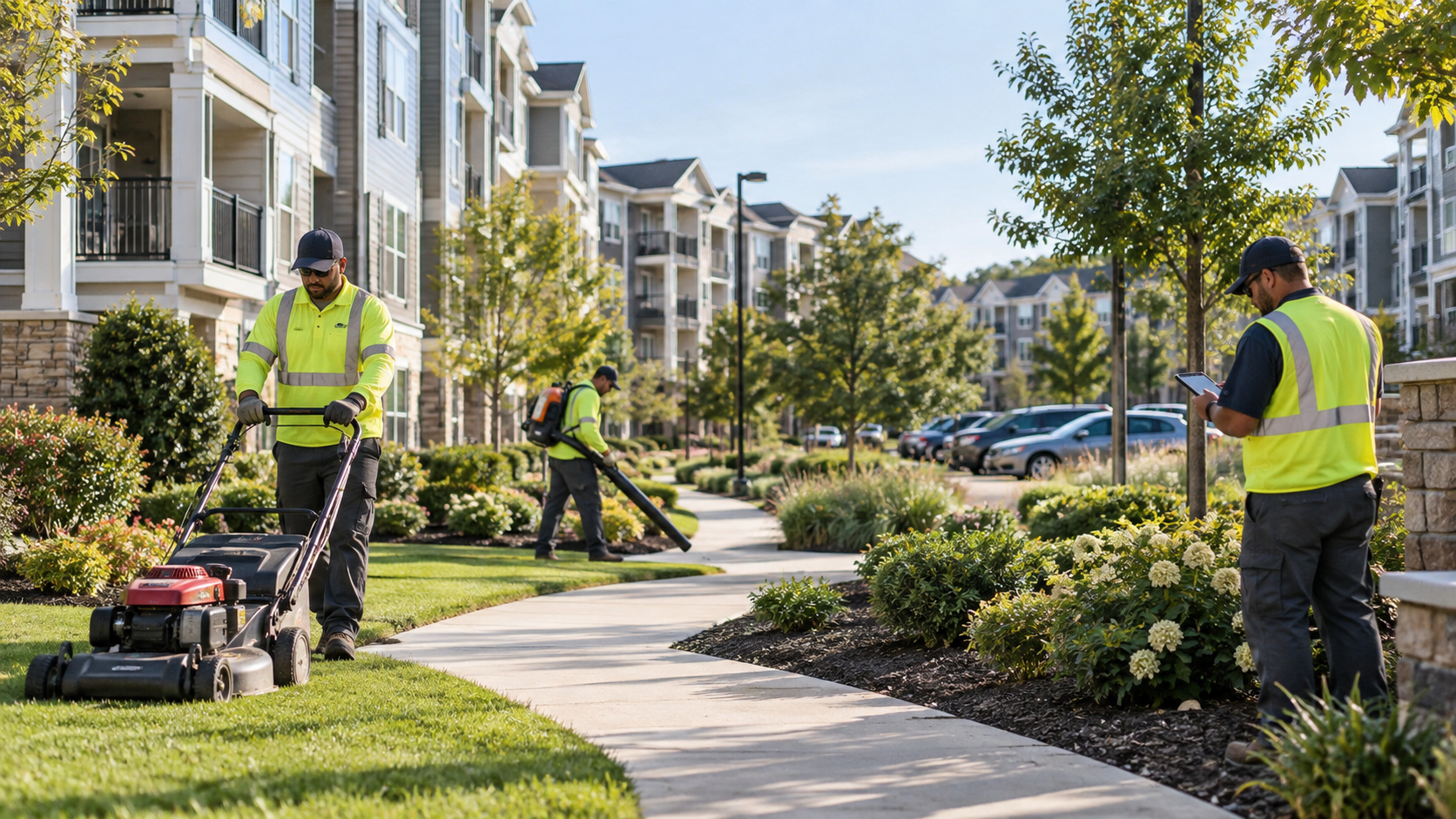
Multifamily landscaping is the recurring care of apartment-community grounds, including turf, beds, entrances, common areas, litter pickup, cleanup and seasonal work. Apartment operators commonly contract this work out while keeping resident-facing building maintenance in-house. Pool operations often follow a separate model, with trained onsite staff or a qualified outside operator depending on the property and local rules.
The goal is not to outsource as much as possible. It is to put each service in the operating model that gives the property team the clearest responsibility, the right expertise and a repeatable standard across communities.
What apartment operators outsource and what stays in-house
Apartment communities use a mixed maintenance model because the work itself is mixed. Residents need fast help with plumbing, HVAC, access, appliances and unit issues. Grounds work follows a route and service calendar. Pest control, security, snow and other specialty services have their own licensing, equipment or staffing needs. Trying to put every category under one staffing model usually creates either too much fixed payroll or too much dependence on outside vendors for everyday resident issues.
A practical split starts with three questions: how often does the service happen, does it require specialist equipment or credentials, and does the property need someone available immediately? Work that is frequent, resident-facing and closely tied to unit operations tends to fit the onsite team. Scheduled exterior work and specialist categories are more natural contract services.
| Service category | Common operating model | Why that model fits | Responsibility to define |
|---|---|---|---|
| Unit repairs and resident work orders | Mostly in-house maintenance team | Fast response and daily property presence | What onsite staff handles vs when a specialist is called |
| Landscaping and grounds | Usually contracted | Recurring route work, equipment and seasonal labor | Exact service areas, frequency and finished standard |
| Pest control | Usually contracted | Specialist products, treatment programs and licensing rules | Routine program vs resident-triggered treatment |
| Snow and ice | Contracted in snow markets | Weather-driven equipment and crew demand | Trigger, response window and priority areas |
| Pool operations | Often in-house or hybrid | Daily checks, resident use and local operator requirements | Who tests, records, adjusts and escalates |
| Major trade repair | Mixed | Onsite team triages; licensed or specialist work goes out | Approval limits and escalation path |
The National Apartment Association uses the same broad distinction in its operating-expense reporting. Its apartment benchmarks separate payroll and repairs and maintenance from payments to outside vendors. Earlier NAA survey definitions explicitly listed landscaping within contract services. That accounting split reflects how many apartment operators already think about the work: the onsite maintenance team is one cost center, while recurring specialist vendors are another.
Source: National Apartment Association, Income/Expense IQ and operating-expense definitions (2024 data).
Landscaping and grounds: commonly outsourced
For professionally managed apartment communities, landscaping is one of the most established contract-service categories. The property may still use maintenance or porter staff for quick litter pickup, small irrigation observations or an urgent cleanup, but the recurring grounds program is usually assigned to a landscaping provider.
The reason is operational. Grounds work needs route density, mowers, trimmers, blowers, transport, seasonal labor and a crew that can spend a defined block of time outside. An apartment maintenance technician has a different job. Pulling that technician away from work orders to mow, edge or handle bed maintenance can leave resident repairs waiting while still failing to create an efficient landscaping route.
A multifamily grounds scope should separate the recurring contractor work from the property team’s everyday ownership of the site. The landscaping provider may be responsible for scheduled turf care, edging, trimming, beds, shrub work, service cleanup and seasonal grounds tasks. The site team still notices blocked drains, irrigation leaks, fallen branches, resident damage or a missed visit and gets the issue into the right workflow.
| Grounds responsibility | Landscape provider | Onsite property team |
|---|---|---|
| Recurring mowing, edging and trimming | Complete to scheduled scope | Report misses or access problems |
| Landscape beds and routine plant upkeep | Maintain areas included in contract | Flag damage or conditions outside normal scope |
| Litter during scheduled visit | Handle defined service areas | Manage day-to-day resident or operational litter between visits |
| Irrigation observations | Report visible leaks or failures if included | Escalate urgent water loss and approve repair path |
| Storm or abnormal debris | Perform only where contract includes it or after approval | Secure hazards and start additional-work process |
| Resident complaints about grounds | Correct service issues when valid | Receive, qualify and route the complaint |
The line between those responsibilities matters more than the label on the invoice. If a contract says “full-service landscaping” but does not define litter areas, seasonal cleanup, irrigation interfaces or what happens after a missed visit, the site team will end up filling the gaps. Across several communities, those gaps become different local operating models.
Detailed landscaping frequencies, seasonal color, mulch and enhancement programs belong in the apartment-landscaping standard for the portfolio. At this level, the essential point is simpler: the recurring grounds scope needs to be complete enough that the onsite maintenance team is not quietly becoming the backup landscaping crew.
Pools: choose qualified in-house, contracted or hybrid coverage
Pools require a different operating decision because they combine equipment maintenance with ongoing operation. Water quality, chemical handling, opening checks, recordkeeping, resident use and closure decisions may require attention between scheduled service visits. Depending on local requirements, staffing and operating preferences, apartment communities may use trained onsite staff, a contracted qualified operator or a hybrid model.
CPO, or Certified Pool and Spa Operator, is one widely recognized training credential used by property managers and aquatic-facility staff. The Pool & Hot Tub Alliance describes the CPO program as training in water balance, chemical testing, troubleshooting, recordkeeping and regulatory guidance. A CPO credential does not replace local code requirements, and a jurisdiction may recognize other operator qualifications.
Source: Pool & Hot Tub Alliance, Certified Pool & Spa Operator program.
The current CDC Model Aquatic Health Code is useful because it recognizes both staffing models. The 2024 MAHC sets out circumstances where a qualified operator is expected onsite or immediately available, while other aquatic facilities may use an onsite qualified operator or a contract with an off-site qualified operator. The MAHC is guidance rather than federal law, so state and local adoption still controls the actual requirement for an apartment community.
Source: CDC, 2024 Model Aquatic Health Code, Sections 6.3.1.1 and 6.3.1.2.
| Pool operating model | Best fit | Main advantage | Main operating issue |
|---|---|---|---|
| In-house trained operator | Property already has qualified onsite staff and daily coverage | Immediate checks and close connection to property operations | Training, staffing continuity and local compliance stay with operator |
| Contracted qualified operator | Portfolio prefers specialist pool operations or lacks onsite qualification | Specialist expertise without adding the same skill to every property team | Visit schedule and off-site availability must match local requirements |
| Hybrid | Onsite staff handles routine checks while specialist handles service, repairs or oversight | Keeps daily visibility while adding specialist support | Responsibilities must be explicit so no task falls between teams |
That makes the pool decision different from landscaping. A landscaping crew does not need to be on the property every day. Pool operation can involve daily checks and immediate judgment about whether the venue should remain open. The right model therefore depends on staffing and local rules, not on a general preference for in-house or outsourced work.
How the split affects your contract and your budget
The outsource-versus-in-house split changes where costs show up and who owns the risk of a missed task. That is why a vendor quote cannot be compared directly with one employee’s hourly wage. The operator needs to compare the full service model.
For grounds work, the contract price normally absorbs crew labor, route planning, standard equipment and the provider’s field supervision. The property still carries internal time for vendor oversight, complaint handling and approval of additional work. For an in-house pool model, the vendor invoice may be smaller, but payroll, training, coverage during vacations or turnover, chemicals, testing supplies and specialist repair still sit somewhere in the operating budget.
NAA’s current benchmarking framework is useful here because it separates payroll, repairs and maintenance, and vendor contract services. A service moved from in-house to outsourced does not disappear from the budget. It moves between categories and changes who carries staffing and execution responsibility.
| Cost or responsibility | Outsourced grounds model | In-house pool model | What portfolio teams should compare |
|---|---|---|---|
| Routine labor | Inside vendor price | Inside property payroll | Fully loaded labor, not wage alone |
| Equipment | Mostly provider responsibility | Pool equipment belongs to property; routine tools/supplies remain onsite | Replacement, storage and repair responsibility |
| Training | Provider manages crew skill for routine grounds work | Operator maintains qualified pool coverage | Training cost and staffing backup |
| Supplies | Routine grounds consumables depend on contract | Chemicals and testing supplies often remain property cost | What is included vs passed through |
| Supervision | Provider plus property/vendor oversight | Property management supervises onsite process | Internal management time |
| Specialist work | Enhancements and repairs often extra | Equipment repairs or specialist pool service may still be contracted | Approval thresholds and change orders |
The cleaner budgeting method is to map every recurring responsibility to an owner before comparing cost. If the property manager assumes the landscape contractor handles irrigation repair while the contractor assumes the maintenance team owns it, the budget is wrong even if both parties priced their own work correctly.
Managing grounds across multiple apartment communities
A single apartment community can tolerate more local judgment. A multi-community portfolio cannot rely on every manager having a different understanding of what “good landscaping” means. The portfolio needs a baseline that travels with the property when managers change, vendors change or a new community is added.
That baseline does not mean every community gets the same visit count or plant program. A property in Phoenix, Atlanta and Minneapolis will have different growing seasons and different irrigation needs. The standard should define the parts that do not need to change: service zones, included tasks, what counts as complete, how additional work is approved, how a missed visit is reported and who owns escalation.
Site addenda then handle the local facts. One property may have a pool deck, dog park and large entrance beds. Another may have mostly turf and surface parking. A third may have courtyards that require access through resident areas. Those differences belong in property-level maps and schedules, not in informal notes held by one manager.
| Portfolio element | Standardize across communities | Allow local variation |
|---|---|---|
| Service categories | Same names and responsibility definitions | Only categories that actually exist at the property |
| Completion standard | Same definition of a complete visit | Property-specific visual details or service zones |
| Service-area documentation | Same map or schedule format | Actual entrances, beds, courtyards, lawns and amenities |
| Frequency process | Same method for setting and approving cadence | Calendar based on climate, growth and property use |
| Issue handling | Same reporting and escalation path | Local contacts and access instructions |
| Additional work | Same approval threshold and change-order process | Local pricing and project scope |
Resident complaints are useful input, but they should not become the primary quality-control system. A resident report can identify a missed edge, blocked walkway or poor-looking bed before the regional team sees it. The operator still needs a defined service standard and a consistent way to decide whether the complaint reflects a contract miss, an out-of-scope request or a new site condition.
Detailed proof-of-completion systems and portfolio reporting belong in their own operating standards. For the grounds contract, it is enough to define what evidence closes the visit, where exceptions are recorded and who follows up when the result does not meet the agreed scope.
What to specify in a multifamily grounds contract
A multifamily grounds contract should be specific enough that a new property manager and a new field crew can read it and reach the same conclusion about what is included. The contract does not need to prescribe how every landscape task is performed. It does need to remove the recurring responsibility disputes that create extra work for the site team.
Before comparing price, normalize the scope across providers. One company may include litter pickup, seasonal cleanup and basic irrigation observation while another prices all three separately. A lower monthly rate is not meaningful until those differences are visible.
| Contract item | What to define | Why it matters in multifamily |
|---|---|---|
| Properties and service areas | Exact communities plus mapped lawns, beds, entrances, amenities and other grounds | Prevents skipped areas and property-level interpretation |
| Recurring scope | Mowing, edging, trimming, bed care, cleanup and other included tasks | Makes provider bids comparable |
| Frequency | Cadence by task, season and property | Keeps seasonal changes planned rather than improvised |
| Resident-facing areas | Entrances, leasing office, amenities, sidewalks and high-visibility zones | Aligns the contract with the areas residents notice most |
| Exclusions | Irrigation repair, tree work, enhancements, storm cleanup or other separate services | Reduces surprise additional charges |
| Missed or incomplete service | Reporting route, correction process and re-service timing | Gives site teams a predictable response |
| Completion documentation | What information or photos close the visit | Supports oversight when regional staff are offsite |
| Change orders | Who can approve additional work and how pricing is documented | Prevents site-level scope drift |
| Escalation | Named owner for unresolved issues | Keeps recurring problems from bouncing between property and vendor |
The HiredHelpr Multifamily Grounds Contract Checklist: map every service area, separate recurring work from extras, set cadence by property and season, define the finished standard, document resident-facing priority areas, establish one missed-service and change-order process, and make the same closeout information required across every community.
That checklist is intentionally operational. It leaves detailed horticultural specifications to the landscaping scope and detailed vendor qualification to the procurement process. Its job is to make the contract usable by the property manager who has to run the community after the agreement is signed.
HiredHelpr provides centralized property services for recurring and on-demand needs, including landscaping and general property maintenance, through one service relationship across multiple properties. For multifamily operators, that model can reduce the number of separate vendor processes regional and site teams manage while the actual work still happens locally at each community.
A clear outsourcing split keeps the property team focused
The strongest multifamily maintenance model is not the one with the highest or lowest outsourcing percentage. It is the one where every recurring service has a clear owner. Landscaping belongs in a defined grounds contract. Resident-facing repairs need a dependable onsite process. Pool operations need qualified coverage that matches the property and local code.
Across several communities, the same split should be documented in a portfolio standard with property-level exceptions. That gives operators room to adapt to different climates, amenities and staffing models without rebuilding the maintenance process at every site.
Contact HiredHelpr to discuss your portfolio, service requirements and coverage needs.
Frequently asked questions
What maintenance do apartment operators usually outsource?
Apartment operators commonly contract recurring specialist services such as landscaping, pest control, snow removal and some major trade work. Onsite maintenance teams usually stay focused on resident work orders, unit repairs, building systems and everyday property issues. The exact split depends on staffing, property type and local requirements.
Is multifamily landscaping usually outsourced?
Yes, multifamily landscaping is commonly structured as a contract service. NAA operating-expense reporting has historically treated landscaping as a contract-service category, separate from onsite payroll and general maintenance. Site staff still monitor conditions and handle issues between scheduled visits.
Should apartment pool maintenance be in-house or outsourced?
Both models can work. Many operators keep routine pool operation with trained onsite staff and outsource repairs or specialist support. Others use a contracted qualified operator. Local pool codes, staffing availability, daily inspection needs and the property’s operating model should determine the choice.
What should be included in a multifamily grounds contract?
The contract should define service areas, recurring tasks, cadence, seasonal adjustments, resident-facing priority areas, exclusions, completion documentation, missed-service procedures, change orders and escalation. Property maps or site schedules are useful when communities have complex courtyards, amenities or separate landscape zones.
How do you manage landscaping across multiple apartment communities?
Use one portfolio baseline for service categories, finished standards, issue handling and approval rules, then add property-specific maps and seasonal schedules. That keeps the operating process consistent while allowing each community to reflect its climate, layout and resident-facing needs.