
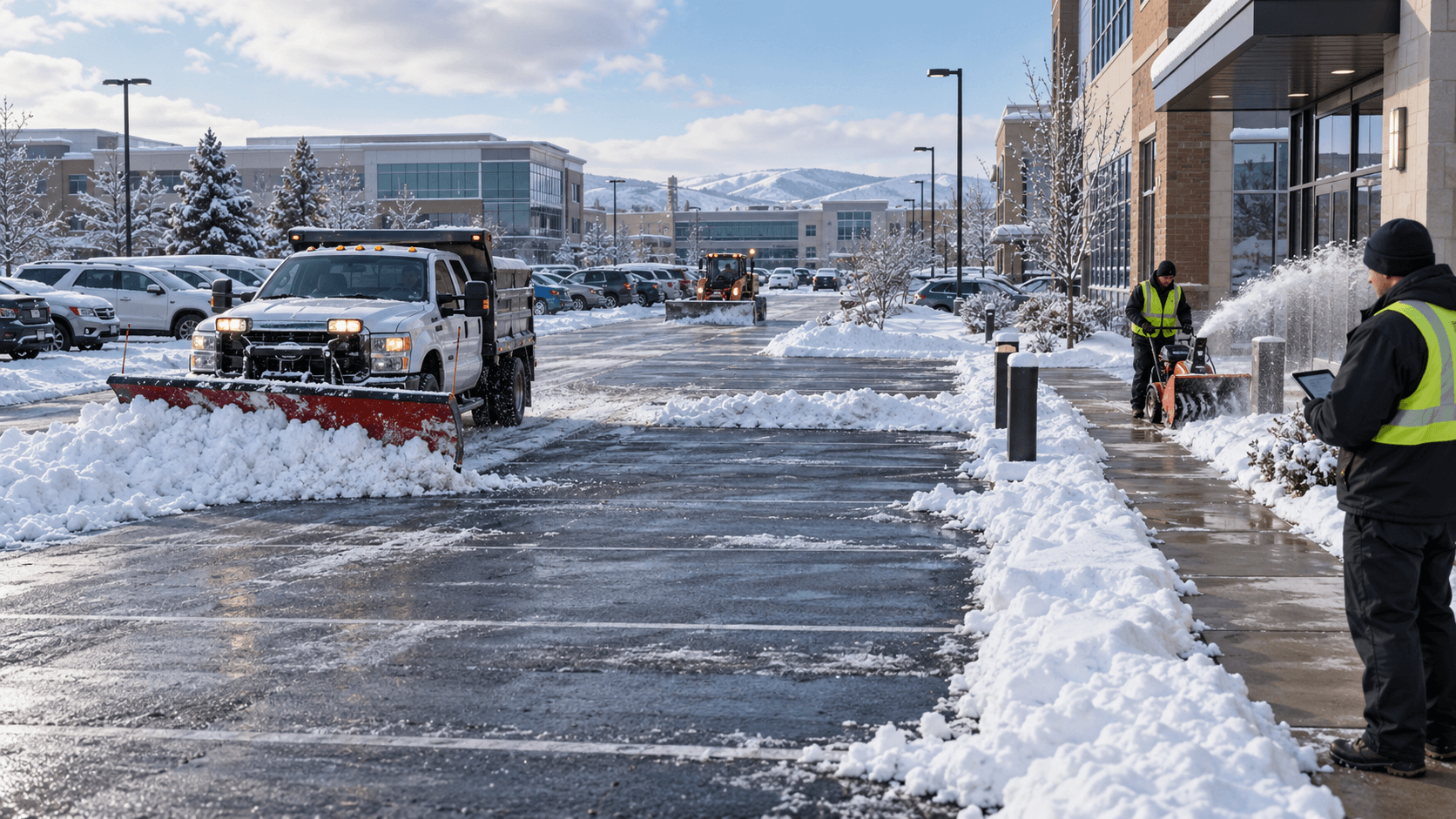
A commercial snow removal contract should spell out which parts of each property are covered, what weather conditions trigger service, and how the provider responds when several sites need attention at once. A broad promise to “clear the property” leaves too much open to interpretation once snow starts falling.
For a multi-site portfolio, use the same contract definitions across locations, then document the differences that matter at each site: priority areas, access limits, local response expectations, and where snow can be stored. This makes the agreement easier to manage and gives both sides a record to work from during an event.
What Commercial Snow Removal Includes at Portfolio Scale
Commercial snow removal can cover more than plowing parking lots. Depending on the site and agreement, work may include clearing vehicle lanes and parking spaces, opening entrances and loading areas, shoveling sidewalks and steps, applying deicing materials, returning during a storm, and relocating or hauling snow when piles block visibility or usable space.
Those tasks should be listed separately. A site can have a plowing trigger for the lot, a different service standard for a main entrance, and ice treatment that is activated by freezing rain or refreezing conditions. “Snow removal” is a service category, not a complete scope.
At portfolio scale, the scope also needs to identify which properties are included and how exceptions are handled. A contract might cover all locations in a region, for example, but exclude a site with restricted access, a steep ramp, a detached garage, or a loading dock that needs to remain open overnight. Put those conditions in the site plan rather than relying on a general service description.
Before comparing proposals, prepare a property list and mark the areas that need service at each location. Identify pedestrian routes, fire lanes, accessible parking, building entrances, loading zones, service roads, and approved snow-storage areas. Note operating hours and any areas that need to stay open throughout the event. The provider can then price and plan against the same scope.
Trigger Thresholds: When Crews Deploy, and Who Decides
A trigger threshold is the condition that starts a specific service. For plowing, it is often a stated snow depth. For ice control, the trigger may be freezing precipitation, known refreezing conditions, or a request from an authorized property contact. The contract should describe each trigger separately and say exactly what work begins when it is reached.
A threshold by itself is not enough. The agreement should say where accumulation is measured, how it is measured, and whether the threshold refers to total snowfall or accumulation on the surface since the last clearing. It should also explain whether crews are dispatched automatically or wait for approval.
| Service | Trigger to define | What the contract should clarify |
|---|---|---|
| Plowing | Agreed snow-depth threshold | Where and how accumulation is measured, and whether repeat passes are included |
| Ice treatment | Freezing precipitation, refreeze risk or an authorized request | Who monitors conditions, who can dispatch, and how materials are billed |
| Return visit | Continued accumulation or a change in site conditions | How often crews return and whether the visit creates an additional charge |
This matters when a storm starts before the property opens, when snow falls intermittently, or when temperatures rise and then drop again. If the trigger applies only once, the provider may make one pass and leave the site to accumulate again. If repeat service is expected, the contract should define the conditions and billing for return visits.
Set authority in advance. The agreement should name who monitors conditions, who can request additional service, and who can approve extra work or material charges. If the provider uses weather monitoring to dispatch crews, confirm how it communicates the dispatch and how the property team can report a local condition the forecast does not capture.
For a portfolio, standardize the definitions, not necessarily the exact threshold at every site. A busy retail property, an office campus and a low-traffic storage facility may need different priorities. Their plans can use the same terms and approval rules while reflecting different operating needs.
Coverage: Confirming Service at Every Site and Market
A provider’s service-area map does not confirm that every property on a portfolio list can be serviced under the proposed terms. Ask the provider to confirm coverage by address, service category and winter season. For each location, establish whether the provider has a local crew, uses a subcontractor, or needs to mobilize resources from another area.
Then ask how the plan holds up during a regional storm. A provider may have enough capacity for normal snowfall in each market but face competing demand when several markets are affected at the same time. Discuss route order, crew capacity, backup equipment, subcontractor oversight and how urgent site issues move up the queue.
Coverage should include the practical details that affect access. Record gate codes, contact requirements, restricted hours, areas where equipment cannot operate, and any approval needed before snow is piled or hauled away. For multiple properties, use a consistent site-plan format so regional staff can see which locations have special instructions.
Treat a coverage commitment as something to verify, not infer from a national or regional claim. Attach the covered-site list to the agreement or its service schedule, and define how a new property is added. Confirm whether adding a site requires a new site walk, different pricing, or a lead time before service can begin.
Response Times and What a Realistic Guarantee Looks Like
A response-time promise should describe a measurable step. “Prompt response” does not say whether the provider will acknowledge the request, dispatch a crew, arrive on site, or finish a specific area within a set period. Those are different commitments, and not all can be guaranteed in the same way during a major storm.
Ask the provider to state the expected sequence: when monitoring begins, which conditions trigger dispatch, how priority routes are assigned, when the first pass is expected, and how often crews return if snow continues. Where exact completion times depend on weather or road conditions, the agreement should say so and explain what updates the client will receive.
A realistic service plan can also set priorities within each property. Keeping an entrance, fire lane or accessible route usable may take precedence over clearing every parking stall. If that is the expectation, list the priority areas and the order in which they are serviced.
For a portfolio, set response expectations by site or market when conditions differ. The goal is a commitment that can be tracked across locations, not one headline response time that ignores travel distance, storm intensity and the provider’s route plan.
Contract Structures: Per-Event, Seasonal, and Hybrid Pricing
Commercial snow contracts commonly use per-event, seasonal or hybrid pricing. Each can work, but the quoted rate is only comparable when both proposals cover the same work and use the same event definitions.
| Pricing model | How it works | Check before comparing |
|---|---|---|
| Per-event or per-push | Charges for each defined service event or visit | Whether one event includes multiple passes, sidewalks, ice treatment and return visits |
| Seasonal | Sets a price for a defined winter period or service scope | Snowfall assumptions, service limits, unusual conditions and coverage dates |
| Hybrid | Combines a base or seasonal charge with event, push or material charges | Which costs are included and which vary with weather or site conditions |
Whichever model you consider, make the billing unit clear. The contract should define an event, a push, a return visit, an hour of equipment time, and any material charge. It should also state whether deicing materials, snow relocation, hauling, sidewalk work and after-hours requests are included.
Compare the total cost under a few plausible winter scenarios, not just the base price. For example, ask each provider to price the same number of visits, the same areas and the same ice-treatment assumptions. This exposes differences in exclusions and extra charges before they show up on an invoice.
Liability, Documentation and Slip-and-Fall Exposure
Hiring a snow contractor does not remove the property operator’s need to oversee site conditions and service performance. The contract should make responsibilities clear, while the property team maintains its own process for identifying hazards, reporting issues and following up on incomplete work. Specific legal duties vary by location and contract, so have counsel review liability, insurance, indemnity and notice provisions.
Confirm the provider’s insurance requirements and what documentation is available if a condition or incident is later questioned. Requirements can include current certificates of insurance, named insured details, subcontractor coverage and prompt notice if coverage changes. The contract should also explain who is responsible for confirming that subcontractors meet the same requirements.
Agree on what an event record should contain. A useful record identifies the property, date and service time, conditions observed, work performed, materials applied where relevant, exceptions, and any return visit or follow-up needed. Photos can help verify particular areas, but the contract should say when they are required and how they are associated with a site and service event.
Consistent records matter when an operator oversees multiple properties. They make it easier to check whether service occurred, spot repeated gaps, and respond to questions without reconstructing the event from separate emails and calls. Keep the provider’s records alongside the property team’s own incident and inspection process.
Why Snow Contracts Are Signed Before the Season Starts
Snow providers plan routes, labor, equipment and materials before winter weather creates an immediate need. Signing early gives both sides time to walk each site, confirm the service map, identify storage areas, agree on triggers, and test the contact and approval process.
It also gives the operator time to compare pricing structures against a consistent scope. Late contracting can leave less room to confirm local capacity or resolve special site requirements, especially when a property needs dedicated equipment, overnight coverage or a narrow response window.
The planning period should include a portfolio review. Confirm the final address list, remove properties no longer in scope, add newly acquired sites, and identify which local contacts can authorize additional service. Share site plans with the people who will handle storm updates, not only the person who signed the agreement.
What to Require Before You Sign
Before signing, make sure the agreement and its site schedules answer these questions:
- Which properties and specific areas are covered?
- Which services are included at each property, and what is excluded or billed separately?
- What condition triggers plowing, ice treatment and repeat visits?
- Where and how are conditions measured, and who authorizes dispatch?
- What response updates and service records will the provider supply?
- How are priorities set when multiple locations need service at once?
- What is the billing unit, and how are materials, hauling and extra work priced?
- How are new sites, changed conditions, missed visits and escalations handled?
- What insurance documentation and subcontractor requirements apply?
Compare the answers against the actual property list, not a general service-area claim. For a related evaluation framework, see the guide to choosing a commercial snow removal company for a multi-site portfolio and the article on comparing property maintenance contracts.
A Snow Contract Should Be Clear Before the First Storm
A snow contract works best when the operating plan is clear before weather puts it to the test. When site scope, triggers, coverage, response expectations, pricing and records are written down, property teams can see what has been agreed and where a local exception needs attention.
HiredHelpr is a tech-enabled national service provider for multi-property operators, managing recurring grounds care, seasonal preparation and responsive maintenance through a vetted vendor network. The questions above can be used as the HiredHelpr Snow Contract Checklist: a vendor-neutral way to compare snow proposals against the same property list and the same definitions.
Contact HiredHelpr to discuss year-round maintenance across your portfolio.
Frequently Asked Questions
Can one snow contract use different trigger thresholds at different properties?
Yes. A portfolio can use shared definitions for measuring snowfall and dispatching service while setting site-specific thresholds or priorities. Record each property’s requirements in its service schedule so crews and property teams know which plan applies.
Does a per-push rate always mean one visit during a storm?
Not necessarily. Providers may define a push as a pass through specified areas, while an event may include multiple visits or tasks. The contract should explain what each billing unit covers, including repeat passes, sidewalks and ice treatment.
What happens if snowfall exceeds the seasonal amount in the contract?
It depends on the agreement. Some seasonal proposals may include limits or additional charges above stated assumptions. Check how snowfall is measured, what amount is included, and how any extra service will be priced and approved.
Are deicing materials included in snow removal pricing?
Not automatically. Confirm which materials and areas are covered, what conditions trigger application, and whether material costs are included in the service rate or billed separately.