
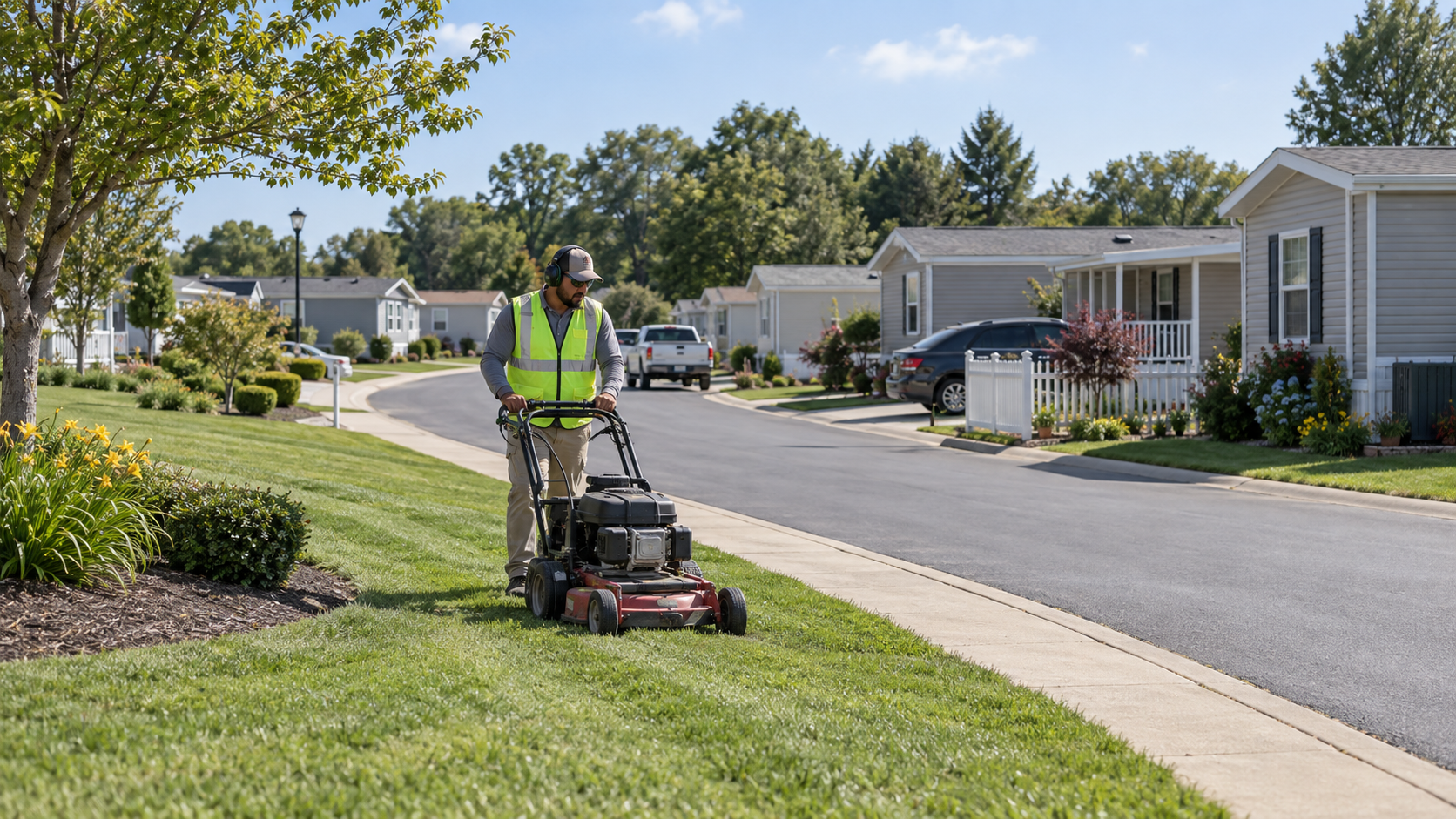
Landscaping at one manufactured housing community is a local maintenance job. Across several communities, it becomes a responsibility and consistency problem. Operators need to know which areas belong to the community, which belong to residents, what the contractor is expected to touch, and how the same standard will be applied when layouts and climates differ.
That boundary is more complicated in manufactured housing than it is in many apartment settings. A community can include shared entrances, roadsides, clubhouses, retention areas and vacant sites alongside individual home lots where resident responsibilities are set by the lease and community rules. If those boundaries are vague, the contractor, site team and resident can each have a different idea of who was supposed to handle the work.
Managing landscaping across multiple manufactured housing communities means defining one portfolio-level grounds standard, then documenting the exact responsibility boundary at each community and lot type. The standard should cover common areas, resident or operator lot responsibilities, service cadence, seasonal exceptions, complaint handling and the process for work that falls outside routine scope.
For operators managing several manufactured housing communities, the goal is not to make every property identical. It is to make the rules clear enough that each community can be different without being managed differently every time.
What grounds maintenance covers at a manufactured housing community
The recurring grounds scope at a manufactured housing community usually starts with the areas the operator controls directly. That can include entrances, medians, roadsides, clubhouse grounds, office areas, mail areas, playgrounds, open green space, retention areas and vacant or operator-controlled lots.
Routine work commonly includes mowing, edging, trimming, weed control in maintained beds, litter pickup and cleanup after service. In practice, mobile home park lawn care is one part of the broader grounds scope. Shrub care, leaf removal and seasonal cutbacks may sit in the recurring schedule or appear as seasonal line items. Larger tree work, irrigation repair, storm cleanup and landscape improvements are better identified separately so routine pricing stays comparable from one community to another.
For turf, a useful service specification is tied to growth rather than a fixed national calendar. NC State Extension recommends mowing often enough that no more than one-third of the leaf surface is removed in a single mowing and notes that weekly mowing is common during active growth. That is a better operating rule than assigning the same monthly schedule to every community regardless of grass type, rainfall and season.
Research reference: NC State Extension lawn maintenance guidance
| Area | Typical recurring work | Common separate work | What the scope must clarify |
|---|---|---|---|
| Entrances and community signage | Mowing, edging, trimming, bed upkeep, litter pickup | New planting, redesign, major irrigation repair | Exact maintained footprint and appearance standard |
| Clubhouse and amenity areas | Turf, beds, walkways and routine cleanup | Major enhancements, tree work, hardscape repair | Whether service includes all amenity edges and gathering areas |
| Roadsides and open space | Mowing, trimming and debris pickup | Brush clearing, drainage work, storm cleanup | Where maintained turf ends and naturalized areas begin |
| Vacant or operator-controlled lots | Mowing and basic cleanup where included | Lot restoration, grading, large debris removal | Which vacant sites are active in the schedule |
| Individual home lots | Depends on lease and community rules | Resident landscaping, owner improvements, corrective work | Who is responsible for turf, beds, trees, fences and cleanup |
This is the first MHC-specific distinction: the grounds contract has to describe both the work and the ownership or responsibility boundary around that work.
Common areas, lot lines and resident-owned lots: who maintains what
Manufactured housing communities do not all use the same responsibility model. In many land-lease communities, the operator owns the land and common infrastructure while the resident owns the manufactured home and rents the homesite. The lease, community rules and applicable state law determine how much of the individual lot the resident must maintain.
Federal rules for HUD-assisted manufactured home space rentals provide a useful baseline for the distinction. The park owner must provide maintenance and management services required under the lease and adequate maintenance of roads, walkways and other common areas, while the owner is not required to maintain the family’s manufactured home. State rules can be more specific. Vermont, for example, places common-area safety and maintenance duties on the park owner while also assigning certain lot responsibilities to residents. That is why a portfolio scope has to reflect the lease and the rules that apply in each market rather than assume one national lot-responsibility model.
Research references: HUD manufactured home space maintenance requirements; Vermont mobile home park rules
For a portfolio operator, the practical lesson is simple: do not ask a landscaping contractor to infer the boundary from the physical site. Give the contractor a site map or written responsibility schedule that identifies what the community maintains and what remains a resident obligation.
| Responsibility model | Community/operator handles | Resident handles | Contract implication |
|---|---|---|---|
| Community-maintained lots | Common areas plus defined portions of individual homesites | Home-specific items excluded by rules or lease | Contract needs a per-lot service standard and a complete active-lot list |
| Resident-maintained lots | Common areas, operator-controlled land and designated shared spaces | Routine lawn or landscape care within the leased lot, as permitted by law and lease | Contract must clearly exclude resident lots unless corrective work is authorized |
| Hybrid model | Common areas plus selected lot tasks such as mowing | Beds, personal plantings or other defined lot items | Scope needs task-level responsibility, not a simple common-area versus lot split |
| Vacant or turnover lot exception | Temporary mowing, cleanup or restoration as assigned | Not applicable while operator controls the site | Work order or schedule should identify when the lot enters and leaves the recurring route |
Lot lines are especially important around fences, skirting, carports, utility connections, sheds, resident plantings and narrow strips between homes. The written boundary is more reliable than a crew making a judgment on site.
Why MHC grounds contracts differ from apartment or BTR contracts
Apartment landscaping is usually easier to define because the operator controls most of the exterior grounds. Build-to-rent communities can introduce per-home yards, but the homes and land are generally managed under one operating model. Manufactured housing adds another layer because ownership, lease obligations and resident-controlled improvements can vary within the same community.
A landscaping crew may move from a community entrance maintained to a portfolio standard to an individual lot where the resident owns the home, has added landscaping with approval, and is responsible for part of the yard. Two lots beside each other can also have different conditions because one is occupied, another is vacant, and a third is being prepared for a new home or resident.
That makes the site inventory more important than it is in a simpler commercial landscape contract. The contractor needs to know not only how many acres or homesites are present, but which areas are active in the recurring route, which areas are excluded, and how changes are communicated when occupancy or responsibility changes.
| Operating issue | Manufactured housing community | Apartment community | Build-to-rent community |
|---|---|---|---|
| Individual lot responsibility | Can be split between operator and resident | Exterior grounds usually operator-controlled | Yard service may be centralized or assigned by lease |
| Resident modifications | Homeowner plantings, fences and exterior improvements can affect scope | More limited exterior resident control | Varies by community rules and lease |
| Vacant-site status | Homesites can enter or leave the route as occupancy changes | Unit vacancy rarely changes grounds footprint | Vacant homes usually remain within the same yard program |
| Scope mapping | Lot-by-lot responsibility can matter | Building and common-area map is often enough | Home-level yard map may be needed |
| Complaint source | Can involve service quality or responsibility disputes | Usually service quality or common-area condition | Often yard standard, shared areas or service timing |
This is why copying an apartment landscaping scope into an MHC portfolio creates problems. The service list may be similar, but the responsibility map is not.
Managing a consistent standard across multiple communities
Consistency does not require identical landscaping. A community in Florida, Arizona and Michigan should not share the same plant palette or seasonal calendar. They can still share the same operating standard.
Start with a portfolio baseline that answers the questions that should not change by market: which categories of areas are maintained, what counts as a completed visit, how exceptions are recorded, how missed work is reported, and who can approve additional work. Then give each community a site schedule covering its local service areas, cadence and exclusions.
The most useful version is a two-layer specification. The first layer is the portfolio standard. The second is the community addendum. That keeps regional differences visible without turning every property into a completely separate contract.
| Keep consistent across the portfolio | Allow to vary by community |
|---|---|
| Definitions of common area, homesite and excluded area | Actual acreage, lot count and maintained footprint |
| Required tasks for each service category | Visit cadence based on growth and season |
| Expected cleanup and finished condition | Grass species, plant material and irrigation conditions |
| How service issues and resident complaints are logged | Local access rules and community-specific restrictions |
| Approval process for out-of-scope work | Seasonal events such as leaf drop, storm cycles or dormancy |
| How scope changes are documented | Vacant-site and turnover-lot status |
A portfolio team should also maintain one current map or site schedule per community. When a home is added, a vacant lot changes status, or a resident responsibility changes under the lease, the service record should change with it. Otherwise the written standard and the crew route drift apart.
Detailed proof-of-completion systems belong in the separate verification article planned for M2. For this article, the requirement is narrower: the operator needs enough documentation to know whether the scheduled areas were serviced and to resolve a dispute without relying only on memory.
Seasonal cycles and resident complaint volume
Landscaping complaints in a residential community are operationally different from complaints at an unmanned commercial site. Residents see the grounds every day. A missed strip of turf, an overgrown common area or debris around a mailbox can generate feedback before the regional team knows a service issue exists.
The useful response is to separate complaints by cause. A service miss needs contractor follow-up. A lot-responsibility dispute needs the lease or community rule checked. A seasonal condition may require a temporary schedule adjustment. A storm-related issue may belong outside the routine landscaping scope entirely.
Seasonality also changes what residents notice. During rapid turf growth, missed mowing becomes visible quickly. During leaf drop, cleanup frequency becomes more noticeable. In dry periods, irrigation issues can make one area look neglected even when mowing is on schedule. In colder markets, snow and winter access become separate operating questions rather than extensions of lawn care.
| Complaint pattern | Likely operational question | Best record to check |
|---|---|---|
| “My lot was skipped” | Is the lot operator-maintained, resident-maintained or temporarily added to service? | Lot responsibility schedule and current route list |
| Common area looks overgrown | Was the visit missed, delayed or scheduled too lightly for current growth? | Service calendar and completion record |
| Debris remains after mowing | Is cleanup part of the finished standard? | Scope wording and service standard |
| Resident landscaping was cut or removed | Was the crew working inside the correct boundary? | Site map, approved resident improvements and lot notes |
| Repeated complaints after weather event | Does the condition fall inside routine service or require separate storm work? | Seasonal scope and change-order process |
Raw complaint counts are hard to compare across communities of different sizes. A 60-homesite community and a 600-homesite community should not be judged by the same absolute number. For portfolio review, normalize recurring complaint categories by occupied homes or by completed service visits and look for repeated patterns at the same community, with the same contractor, or during the same part of the season.
Complaints are not a substitute for quality control, but they are useful operational data. When the same issue keeps appearing, it often points to a scope, frequency or responsibility problem that needs to be corrected at the system level.
What to require from a grounds contractor at an MHC portfolio
An MHC portfolio contract needs to do more than list mowing and trimming. It should give the contractor enough information to work across multiple communities without making responsibility decisions on the fly.
Before comparing pricing, normalize the scope. Two proposals are not comparable if one includes resident lots, vacant sites and seasonal cleanup while the other covers common areas only.
- Community and service-area schedule. List every community and identify the common areas, operator-controlled lots, vacant sites and other areas included in recurring service.
- Lot responsibility rules. State which homesite tasks belong to the operator and which remain with residents, subject to the lease and applicable law.
- Recurring scope. Define mowing, edging, trimming, bed work, litter pickup and cleanup requirements rather than relying on the word landscaping.
- Cadence and seasonal adjustment. Set the normal service pattern and the process for increasing, reducing or pausing visits as growth and weather change.
- Finished standard. Describe what the site should look like after service, including edges, hard-surface cleanup and excluded areas.
- Resident and site exceptions. Document approved plantings, fences, access restrictions, vacant sites and other conditions that alter normal service.
- Missed-service process. Define how the community reports a missed or incomplete visit and who owns the correction.
- Out-of-scope approval. Require authorization before larger tree work, irrigation repairs, storm cleanup, enhancements or other non-routine work begins.
- Scope-change process. Give the portfolio team a simple way to add or remove lots, service areas and communities without creating side agreements.
- Review cadence. Review recurring issues, seasonal changes and open scope questions on a defined schedule instead of waiting for contract renewal.
A useful portfolio check is to ask three questions: what was supposed to happen, where was it supposed to happen, and who owns the next step when it does not? For manufactured housing landscaping, those answers start with a clear responsibility map.
| Contract item | Minimum requirement | MHC-specific reason |
|---|---|---|
| Service map | Maintained areas identified by community and lot type | Physical proximity does not always equal operator responsibility |
| Resident boundary | Lease and rule responsibilities reflected in the scope | Prevents crews from treating every homesite the same |
| Cadence | Normal schedule plus seasonal adjustment process | Growth cycles differ across markets and seasons |
| Vacant sites | Rules for adding, removing and restoring sites | Route lists change as communities change |
| Exceptions | Approved resident improvements and access conditions documented | Protects resident-controlled areas and reduces disputes |
| Issue handling | Named reporting and correction path | Resident complaints need a predictable route to resolution |
| Additional work | Approval required before non-routine work | Keeps routine grounds pricing separate from repairs and projects |
One portfolio standard, clear responsibility at every community
Manufactured housing landscaping becomes difficult when three things are mixed together: the community standard, the individual site layout and the resident responsibility boundary. Separating those pieces makes the contract easier to manage and gives local crews clearer instructions.
A portfolio can use one operating framework while allowing each community to have its own service map and seasonal calendar. That is the balance multi-community operators need: consistent expectations without pretending every property works the same way.
HiredHelpr supports recurring landscaping and broader property maintenance through a centralized service model with local execution, giving multi-property teams one service relationship for work across their portfolio.
Contact HiredHelpr to discuss your portfolio, service requirements and coverage needs.
Frequently asked questions
Who is responsible for lawn care in a manufactured housing community?
Responsibility varies by community, lease and state law. Operators commonly maintain shared areas and operator-controlled property, while individual lot maintenance may be assigned to the resident, the operator or split by task. The landscaping scope should follow the written responsibility rules rather than assumptions made on site.
What should mobile home park lawn care include?
A recurring mobile home park lawn care scope commonly covers mowing, edging, trimming, routine bed upkeep, litter pickup and cleanup in the areas assigned to the operator. Seasonal cleanup, irrigation repair, tree work and landscape improvements should be identified separately when they are outside the recurring baseline.
How often should an MHC be mowed?
During active turf growth, weekly mowing is a common planning assumption, but the schedule should follow grass growth and the one-third mowing rule rather than a fixed national calendar. Climate, turf species, rainfall, irrigation and the required appearance standard determine when the cadence needs to change.
How do you standardize landscaping across multiple manufactured housing communities?
Use one portfolio baseline for service definitions, finished standards, issue handling and scope changes. Give each community its own addendum or site schedule for maintained areas, resident responsibility boundaries, local cadence and seasonal exceptions.
How should resident landscaping complaints be handled?
First identify whether the issue is a missed service, a quality issue, a resident-responsibility question or work outside the routine scope. Then check the site map, lease or community rules and service record before assigning follow-up. Repeated complaint categories should be reviewed for a broader scope or scheduling problem.
What should an MHC landscaping contract require?
The contract should identify every serviced community, common areas and lot responsibilities, recurring tasks, cadence, seasonal adjustments, finished standards, resident and site exceptions, missed-service handling, approval for extra work and a process for changing the route as homesites and communities change.