
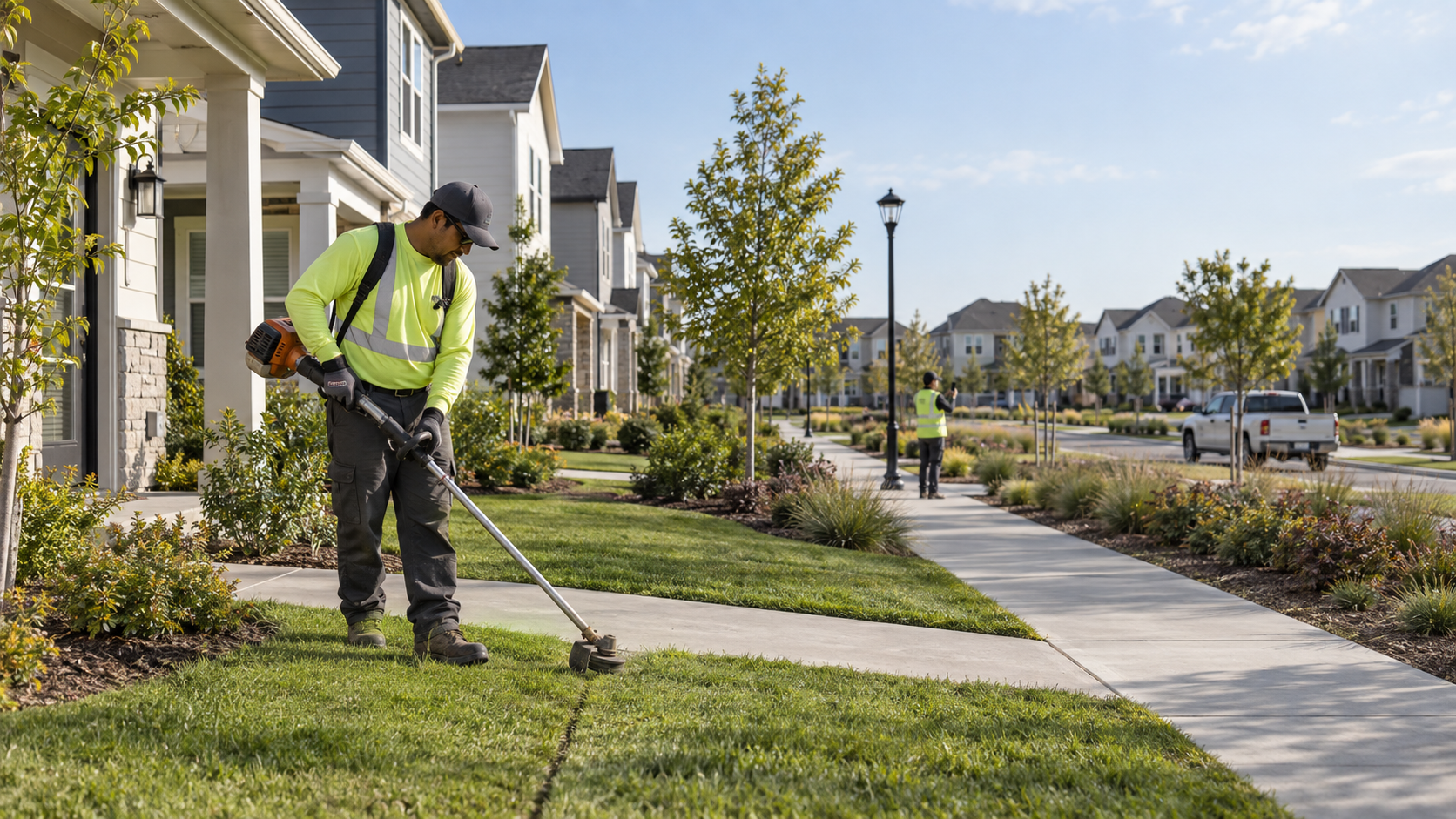
A build-to-rent community combines the maintenance footprint of individual homes with the operating needs of a managed rental community. Each home has its own exterior, mechanical systems and turn work. The community may also have private roads, landscaped entrances, walking areas, amenity spaces and shared grounds. Across several communities, keeping all of that consistent becomes an operating-system problem in its own right.
The National Rental Home Council defines build-to-rent housing as new single-family homes built expressly for renting, including detached homes, townhomes, duplexes and other single-family formats. That purpose-built model gives operators more control over standards than a typical scattered-site rental portfolio, but it also means the maintenance program has to work at both the home level and the community level.
BTR community maintenance is the coordinated upkeep of individual rental homes, private yards, shared areas, turns and seasonal services across a purpose-built rental community or portfolio. A workable portfolio standard separates per-home work from community work, defines how recurring and on-demand service is handled, and records the local exceptions that change from one community or market to another.
For an operator with several BTR communities, the practical aim is a maintenance process predictable enough that adding another community does not require inventing a new system.
How maintenance works across a build-to-rent portfolio
BTR maintenance sits between two familiar property-management models. It has the shared-community needs of multifamily, but the physical asset is a collection of homes. That creates more individual roofs, HVAC systems, water heaters, yards, fences, garages and exterior surfaces per door than a conventional apartment building.
CBRE describes BTR communities as professionally managed rental communities where the operator handles leasing, landscaping, repairs and maintenance across the property.(CBRE Research) also notes that lawn and landscaping are normally handled by management in BTR, unlike many scattered single-family rentals where the resident is responsible for the yard.
That means a BTR maintenance plan needs more than a general vendor list. The operator has to decide which work is scheduled, which work is triggered by a resident or site team, which work belongs to the home, and which work belongs to the community.
| Maintenance layer | Typical examples | What triggers the work | What the portfolio standard needs to define |
|---|---|---|---|
| Home-level recurring | Filter changes, preventive checks, yard service where included | Calendar or service cycle | Included tasks, access process, completion standard |
| Home-level on-demand | HVAC, plumbing, electrical, appliance or exterior repair | Resident or site request | Priority rules, approval path, escalation |
| Community recurring | Shared landscaping, litter pickup, amenity and common-area upkeep | Recurring schedule | Serviced areas, cadence, finished condition |
| Turn work | Cleaning, repairs, rekeys, yard reset, removal of left-behind items | Move-out | Handoff sequence, readiness standard, approval limits |
| Seasonal or event-driven | Storm cleanup, freeze preparation, seasonal grounds work | Season or weather event | Trigger, coverage, communication and exception handling |
One vendor can cover several of these categories. Each still needs its own rules. A recurring lawn service and an urgent plumbing repair are both maintenance, but they have different triggers, timelines and ways of confirming that the work is complete.
Per-home lawn care vs shared common areas
Landscaping is one of the clearest places where BTR differs from both apartments and scattered single-family rentals. In an apartment community, most grounds work happens in shared areas. In BTR, the operator can be responsible for dozens or hundreds of individual yards as well as the entrances, medians, amenity areas and other community grounds.
The first decision is the responsibility model. Some operators include all front and back yard service in the community program. Others maintain front yards and shared areas while residents handle fenced back yards. A third model leaves more lawn responsibility with the resident. The right choice depends on the product and lease structure, but the contract with the grounds provider has to match it exactly.
| Responsibility model | Operator-maintained areas | Resident-maintained areas | Main operational risk |
|---|---|---|---|
| Full-service yard model | Private yards plus all shared grounds | Little or none | Large route and access scope if homes or yards are missed |
| Hybrid model | Front yards, streetscapes, entrances, amenities and common areas | Selected fenced or private yard areas | Confusion at lot boundaries and inconsistent appearance |
| Resident-led private yards | Shared grounds and community-facing landscape only | Most private-lot lawn care | Community standard depends partly on resident compliance |
For multi-community operators, a map is more useful than a paragraph of contract language. Each property should have a service-area map or site schedule showing which yards, medians, detention areas, entrances, trails and amenity zones are part of the recurring scope. Private yards that require gate access or resident coordination should be called out separately.
The finished standard also needs to be consistent. A portfolio can allow different grass types, plant palettes and service calendars while still using the same definition of a completed visit: the assigned areas were serviced, edging and cleanup were finished, obvious debris was removed, and exceptions were recorded rather than silently skipped.
Coordinating turns, grounds and seasonal work in one contract
BTR operators deal with several maintenance cycles at the same time. Grounds work follows a recurring calendar. Turns begin at move-out. Repairs arrive unpredictably. Seasonal work is tied to weather and local conditions. If each workstream has a separate request process, approval path and vendor contact, the site team ends up coordinating the system instead of managing the property.
Turn volume in BTR is also different from conventional multifamily. In a 2024 ULI panel discussion, participants described typical BTR turnover underwriting at about 35 percent, against roughly 45 to 50 percent for horizontal-apartment products. Those figures come from practitioner discussion, so they are directional.(Urban Land Institute)
Lower turnover reduces how often homes turn, though a single-family turn can involve more space, exterior conditions and yard work than an apartment turn.
The portfolio-level requirement is a clear handoff. When a resident moves out, the home should move into one turn workflow that identifies interior repair, cleaning, rekeying, exterior issues and yard reset before the home returns to leasing. The detailed turn sequence belongs in a dedicated turn standard, but the BTR maintenance agreement still needs to identify who owns each step and who closes the job.
| Workstream | Trigger | Coordination question | Useful contract language to define |
|---|---|---|---|
| Recurring grounds | Calendar | What is included at each community and lot type? | Service areas, cadence, seasonal adjustment rules |
| Turn work | Move-out | Who opens the work package and confirms readiness? | Included tasks, approval limits, closeout standard |
| On-demand repair | Resident or site request | Who triages and assigns the work? | Priority class, escalation and authorization |
| Seasonal service | Weather or seasonal date | Who decides when the seasonal scope changes? | Trigger, local exception and communication process |
| Additional project | Site condition or planned improvement | Who approves work outside recurring scope? | Quote and change-order process |
One contract still allows several crews. What it standardizes is the set of rules for requesting work, approving exceptions, documenting completion and escalating problems. That is what keeps the maintenance program from fragmenting as the service mix grows.
Why scattered-site SFR is harder to service than BTR
Strictly speaking, scattered-site single-family rental and purpose-built BTR are different operating models. BTR normally refers to homes built and operated as a dedicated rental community. Scattered-site SFR consists of homes distributed through neighborhoods or markets. The distinction matters because maintenance efficiency depends heavily on physical concentration.
The Urban Land Institute has described the BTR operating model as closer to traditional multifamily than scattered-site SFR because the homes sit in one location.(ULI research on single-family rental and BTR)
A concentrated community gives the operator a common access point, a repeatable route and a site team that can see conditions across the property.
| Operating factor | Dedicated BTR community | Scattered-site SFR portfolio |
|---|---|---|
| Travel between homes | Homes are concentrated in one community | Crews travel between addresses and neighborhoods |
| Access | Common site rules and familiar property layout | Access instructions can differ by home |
| Grounds work | Private yards and common areas can be routed together | Yard responsibility and service scope can vary by property |
| Issue visibility | Site staff can spot recurring community patterns | Problems are more dependent on resident or remote reporting |
| Vendor coverage | One provider can serve many homes in a compact route | Coverage depends on geographic spread and route economics |
| Standardization | Homes often share similar age, design and materials | Asset age and specifications vary more widely |
A dedicated community is easier to route, though the workload stays substantial. One hundred homes still mean one hundred roofs, HVAC systems, water heaters and yards. The operational advantage comes from concentration and repeatability. The asset count does not fall.
For operators managing both BTR communities and scattered SFR, it helps to keep the service standards consistent while allowing different dispatch models. The definition of a completed repair, turn or grounds visit can stay the same even when travel, access and vendor assignment differ.
Standardizing scope across communities in different states
A portfolio operating in several states needs one maintenance language and several local schedules. Standardization here applies to definitions and process, while the schedules stay local.
The portfolio baseline should define the things that do not need to change every time a new community is added: service categories, work-order fields, who can approve additional work, what counts as complete, how missed work is escalated and which information closes a service request. Community addenda then handle the parts that are genuinely local.
| Keep consistent across the portfolio | Localize by community or market |
|---|---|
| Definitions for recurring, on-demand, turn and project work | Seasonal calendar and grounds cadence |
| Required work-order information | Climate-driven grounds requirements |
| Approval and change-order process | Property layout and service-area maps |
| Completion and closeout standard | Access instructions and resident coordination |
| Escalation ownership | Local vendor coverage and trade availability |
| Reporting fields and naming conventions | State or local compliance addenda |
This structure also makes acquisitions and new-community onboarding easier. Instead of starting with a blank maintenance plan, the operator starts with the portfolio baseline and records only the differences. A new market may require a different seasonal calendar, different vendors and different access rules, but it does not need a different definition of a completed work order.
State and local maintenance obligations can vary. Those compliance details belong in a local addendum and should be reviewed separately rather than buried inside a national scope of work. The operating standard can stay national while the legal and technical requirements remain local.
The same approach works for service performance. Portfolio leadership can compare communities only when the basic fields are the same. If one market records a missed visit as a service failure and another market records it as a scheduling note, the reporting will look different even when the underlying problem is identical.
What BTR operators should require from a maintenance provider
A BTR maintenance provider needs to support the way the portfolio is actually organized. Trade skill matters, but so do coverage, coordination and the ability to work from a documented standard across multiple communities.
Before comparing pricing, operators should normalize the scope. One proposal may include private-yard service, seasonal cleanup and turn-related exterior work while another excludes all three. A lower recurring price is not meaningful until the services and assumptions line up.
| Requirement | What to define | Why it matters for BTR |
|---|---|---|
| Community coverage | Exact properties, homes and shared areas covered | Prevents gaps when the portfolio spans markets |
| Per-home vs common-area scope | Which yards, streetscapes and amenities are included | Removes lot-level responsibility disputes |
| Recurring and on-demand process | How scheduled work and repair requests enter the system | Keeps site teams from managing separate workflows |
| Turn coordination | What the provider owns during move-out and make-ready work | Reduces handoff gaps between interior, exterior and grounds work |
| Seasonal exceptions | How cadence or scope changes by market and season | Keeps one national standard usable in different climates |
| Completion documentation | What information closes a job | Provides visibility when portfolio leaders are off site |
| Escalation | Named ownership and the route for unresolved service issues | Makes correction predictable across communities |
| Change orders | Who approves work outside recurring scope | Prevents site-level scope drift |
Detailed vendor qualification, proof-of-completion systems and portfolio reporting deserve their own standards. At this stage, the BTR contract only needs to make those interfaces explicit: who is qualified to perform the work, what evidence closes a job, where service data is recorded and who owns the problem when the first attempt does not resolve it.
The HiredHelpr BTR Portfolio Maintenance Checklist: define the homes and shared areas in scope, separate recurring work from turns and on-demand repairs, document community-specific exceptions, set one approval and escalation process, and require a consistent closeout record for every completed service. The purpose is consistent operating rules, so portfolio teams can manage different communities through the same process.
HiredHelpr provides centralized property services for recurring and on-demand needs, including landscaping and general property maintenance, with one service relationship across multiple properties. For BTR operators, that model can reduce the number of separate vendor processes that regional and site teams have to manage while local work continues to be completed at the community level.
A BTR maintenance model has to work at the home and portfolio level
BTR maintenance covers individual homes, private yards, shared grounds, turns and repairs at the same time, while keeping the resident-facing standard consistent across the community.
Across several communities, the strongest model is a portfolio baseline with local addenda. The baseline defines how work is requested, approved, completed and escalated. The local layer accounts for climate, property layout, access and market-specific service needs. That lets the portfolio grow without rebuilding the maintenance process every time a new community is added.
Contact HiredHelpr to discuss your portfolio, service requirements and coverage needs.
Frequently asked questions
What is BTR community maintenance?
BTR community maintenance is the coordinated upkeep of individual rental homes and the shared areas around them. It includes recurring community services, home-level repairs, turn work and seasonal needs, all managed through a common operating standard across the community or portfolio.
Who usually handles lawn care in a build-to-rent community?
In purpose-built BTR communities, management commonly controls the landscaping program so the community can maintain a consistent appearance. The exact responsibility for front yards, back yards and fenced private areas depends on the lease and property model, so those boundaries need to be documented in the service scope.
How is BTR maintenance different from apartment maintenance?
BTR combines shared-community maintenance with a much larger number of individual home systems and exterior surfaces. Each home can have its own roof, HVAC equipment, water heater, yard, fence and garage, while the operator also manages entrances, amenities and other shared areas.
How should turns be coordinated across a BTR portfolio?
A move-out should trigger one defined turn workflow covering the interior, exterior and yard work required to return the home to the portfolio standard. The operator should define who opens the work package, who approves additional work and who confirms that the home is ready to return to leasing.
How do BTR operators standardize maintenance across different states?
Use one portfolio baseline for service definitions, work-order information, approvals, completion standards and escalation. Add community or market-specific schedules for climate, access, local vendor coverage and regulatory requirements. This keeps the process consistent without forcing identical maintenance schedules everywhere.
What should a BTR maintenance contract include?
A BTR maintenance contract should define the communities and service areas covered, per-home and common-area responsibilities, recurring and on-demand workflows, turn coordination, seasonal exceptions, completion documentation, escalation, change-order approvals and the process for adding or changing communities.