
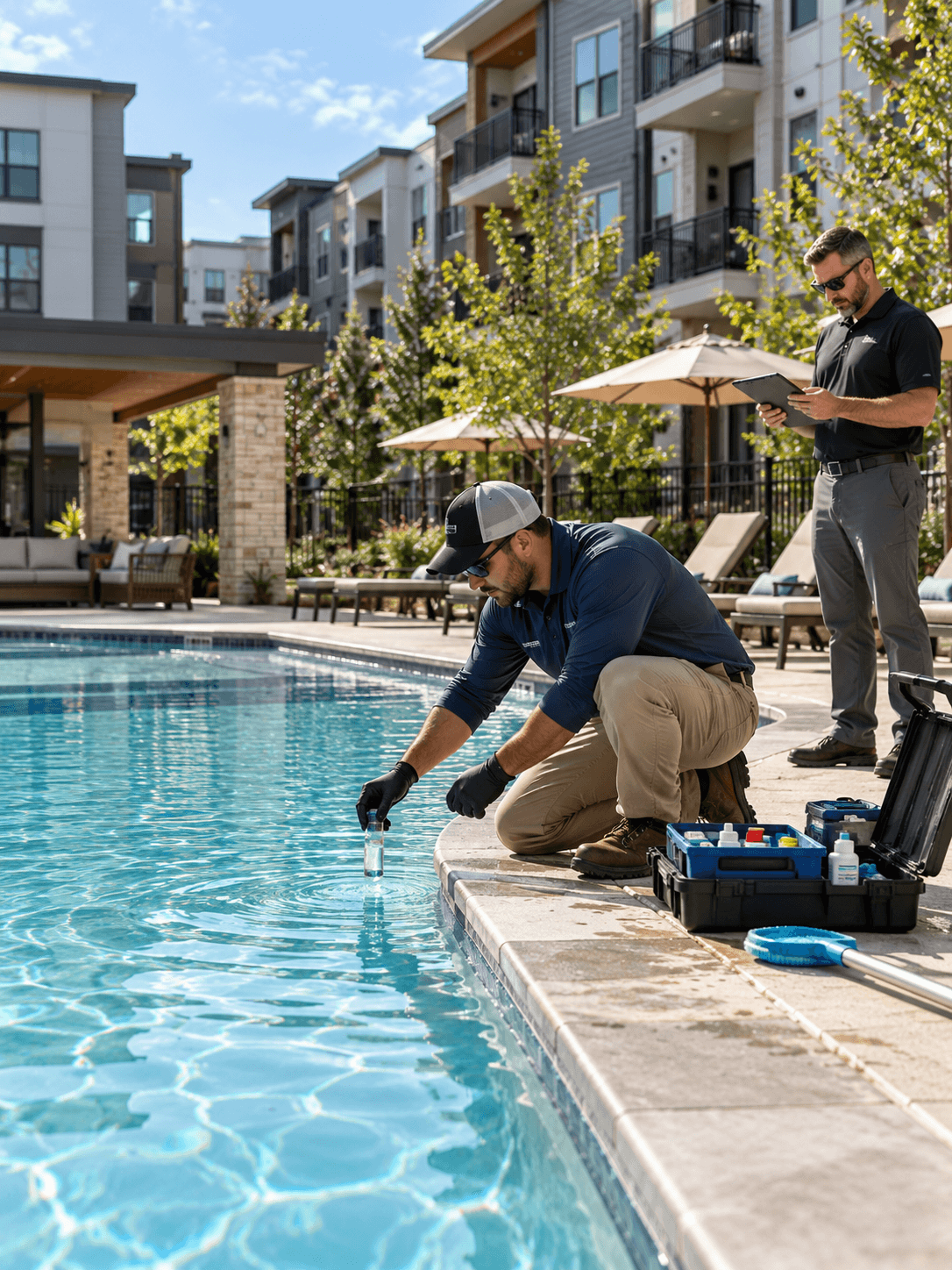
Pool service for apartment communities can be handled by trained employees, an outside provider or a combination of both. The suitable arrangement depends on who can cover the required operating tasks throughout the pool’s opening hours, including the days between scheduled service visits.
A maintenance contract and a staff certification answer different questions. The contract defines the work purchased. A certified pool and spa operator credential, commonly called CPO, reflects operator training. Property teams still need to confirm the qualifications and operating arrangements accepted by the authority responsible for their pool.
What Apartment Communities Outsource for Pool Service
An outsourced scope may include cleaning, water testing and treatment, filter maintenance and routine equipment observations. Seasonal opening and closing, equipment repairs and extra visits may be separate services. Ask the provider to distinguish each item.
The service schedule should explain what happens during a visit and who covers checks between visits. Deck housekeeping, gate checks, resident concerns and an unexpected water-quality problem can require attention while the provider is elsewhere.
A clean-looking pool is only one part of the operation. Records should identify the readings taken, work performed and defects found, with a clear route for decisions that require the property’s approval.
When In-House CPO-Certified Staffing Works Well
A trained employee who already works at the community can respond to changing conditions and coordinate with the onsite team. This can be useful at a heavily used pool or a property with staff available throughout its operating schedule.
The arrangement needs protected time. If the same employee handles apartment repairs and unit turns, pool work can become difficult to cover during busy periods. Certification also needs to sit within a practical operating plan, with suitable equipment and backup personnel.
Pros of keeping pool service in-house
- An onsite employee can respond when readings or conditions change between scheduled visits.
- The pool team already knows the property, its residents and its operating schedule.
- The property team supervises the work directly.
Cons of keeping pool service in-house
- Pool tasks compete with repairs, unit turns and resident requests during busy periods.
- Certification, training and absence cover remain the operator’s responsibility.
- Equipment expertise depends on the experience of individual employees.
| Consideration | In-house staff | Outsourced provider |
|---|---|---|
| Onsite availability | Tied to staffing hours and competing duties | Tied to visits and agreed response coverage |
| Training | Operator manages credentials and ongoing training | Operator verifies the assigned provider’s qualifications |
| Absence coverage | Needs another suitable employee or backup contractor | Depends on provider staffing and replacement arrangements |
| Equipment expertise | Varies with staff experience | Varies with the contracted scope and technicians |
| Supervision | Property team directly oversees the work | Property team reviews records and contract performance |
In-house service can work well when the operator has reliable coverage and the time to supervise it. The cost comparison should include the work that staff will no longer be available to perform elsewhere.
When Outsourcing Pool Service Makes Sense
Outsourcing can be useful when a community lacks suitable staff, has difficulty covering absences or needs recurring specialist support. It may also help a regional team apply common service and documentation requirements across several communities.
A hybrid model can preserve an onsite response while contracting specialist maintenance. For example, the community may retain designated operating checks and resident communication while a provider handles scheduled cleaning and equipment service. Allocate each task in writing and verify that the arrangement meets applicable requirements.
Outsourcing should produce a workable coverage plan. Confirm who receives an out-of-range reading, who can close the pool and who handles a problem before the next scheduled visit.
Comparing In-House Cost Against a Service Contract
Compare the same scope over the same operating season. An employee’s hourly wage and a provider’s monthly fee are incomplete figures if they exclude different tasks. Include labor burden, training, supplies and backup coverage.
Separate planned maintenance from repairs and capital replacement. The provider’s fee may include chemicals but exclude a pump repair. An internal budget may include chemicals in a different account, making the employee model appear cheaper than it is.
| Cost component | Include in the internal model | Confirm in the contract model |
|---|---|---|
| Routine labor | Task hours, payroll burden, supervision | Visit frequency and included tasks |
| Supplies | Chemicals, test materials, cleaning supplies | Inclusions and additional charges |
| Training and coverage | Certification, training time, leave cover | Qualified replacements and backup visits |
| Repairs | Diagnosis, labor, parts and approval process | Exclusions, callout fees and repair pricing |
| Management time | Schedules, records and inspection preparation | Report review, coordination and escalations |
Use actual hours from a representative part of the season where possible. If the decision is based on estimates, label them and review the assumptions after operations begin.
Compliance, Inspections and Record-Keeping Obligations
Pool operating rules depend on the jurisdiction and the facility’s classification. The CDC’s Model Aquatic Health Code is guidance; it becomes law only when adopted by a relevant jurisdiction. Its existence does not establish a single nationwide operating rule for apartment pools.
Confirm requirements with the responsible authority for each community. These may affect operator qualifications, testing frequency, records and closure procedures. The Pool & Hot Tub Alliance’s licensing and certification guidance also notes that licensing is not uniform across the country.
Identify who holds the operating records and who presents them during an inspection. Assign responsibility for responding to inspection findings. Keep qualification records current and verify backup coverage when the designated operator is absent.
Managing Pool Service Across Multiple Communities
Create a pool register with each facility’s identifier, operating season, equipment, responsible authority and designated contacts. Include the onsite and provider tasks, rather than relying on one general regional instruction.
Use a common report format across the portfolio while preserving local requirements. Separate a completed cleaning visit from an unresolved equipment defect or a closure. Regional teams should be able to see which issue needs a decision without searching individual messages.
The same principle underlies consistent service across multiple properties: shared expectations need to work alongside property-specific schedules and conditions. For how pools fit into the wider outsourcing split at apartment communities, see what apartment operators outsource for grounds maintenance.
What to Specify in an Apartment Pool Service Contract
The agreement should name the pools covered, the service season, visit frequency and work included. Document responsibilities between visits, qualification requirements, record delivery and the process for additional work.
Include a practical escalation process for missed service, water-quality concerns and equipment defects. Confirm repair approval limits, backup staffing and the information required before reopening after a closure. State which decisions remain with the operator.
HiredHelpr provides recurring pool cleaning and maintenance for multi-property operators through its vetted vendor network, with each visit recorded in the client portal. The community plan should still set out which operating checks stay with onsite staff between visits.
Choose the Pool Model That Covers Every Required Task
In-house staff, an outside provider and a hybrid model can all work. The right arrangement is the one that covers every required check, keeps records the authority will accept and gives the property team a clear route when something goes wrong between visits.
The contract points above can be used as the HiredHelpr Apartment Pool Service Scope Sheet when comparing in-house, outsourced and hybrid arrangements.
Contact HiredHelpr to discuss your portfolio, service requirements and coverage needs.
Frequently Asked Questions
Does every apartment pool need a CPO-certified employee?
There is no single answer for every jurisdiction. Confirm the accepted qualifications and staffing requirements with the authority responsible for the pool. An outsourced operator may be part of the arrangement, but the proposed coverage still needs to satisfy the applicable rules.
Does a weekly pool service visit cover every operating check?
Only if the complete arrangement covers the checks required at that property. A weekly contract alone does not establish adequate coverage between visits. Identify the required checks and assign them to named personnel or the provider.
Is a hybrid pool service model cheaper?
It can be, but the comparison depends on the tasks retained onsite, specialist visits and backup requirements. Calculate the combined cost and management time for the same scope before comparing it with a fully internal or outsourced model.
Should chemical supplies be included in the contract price?
Either approach can work if the pricing is clear. Specify included products, any allowances or caps, extra-charge approval and how usage is reported. Compare proposals using the same assumptions about supplies and the operating season.