
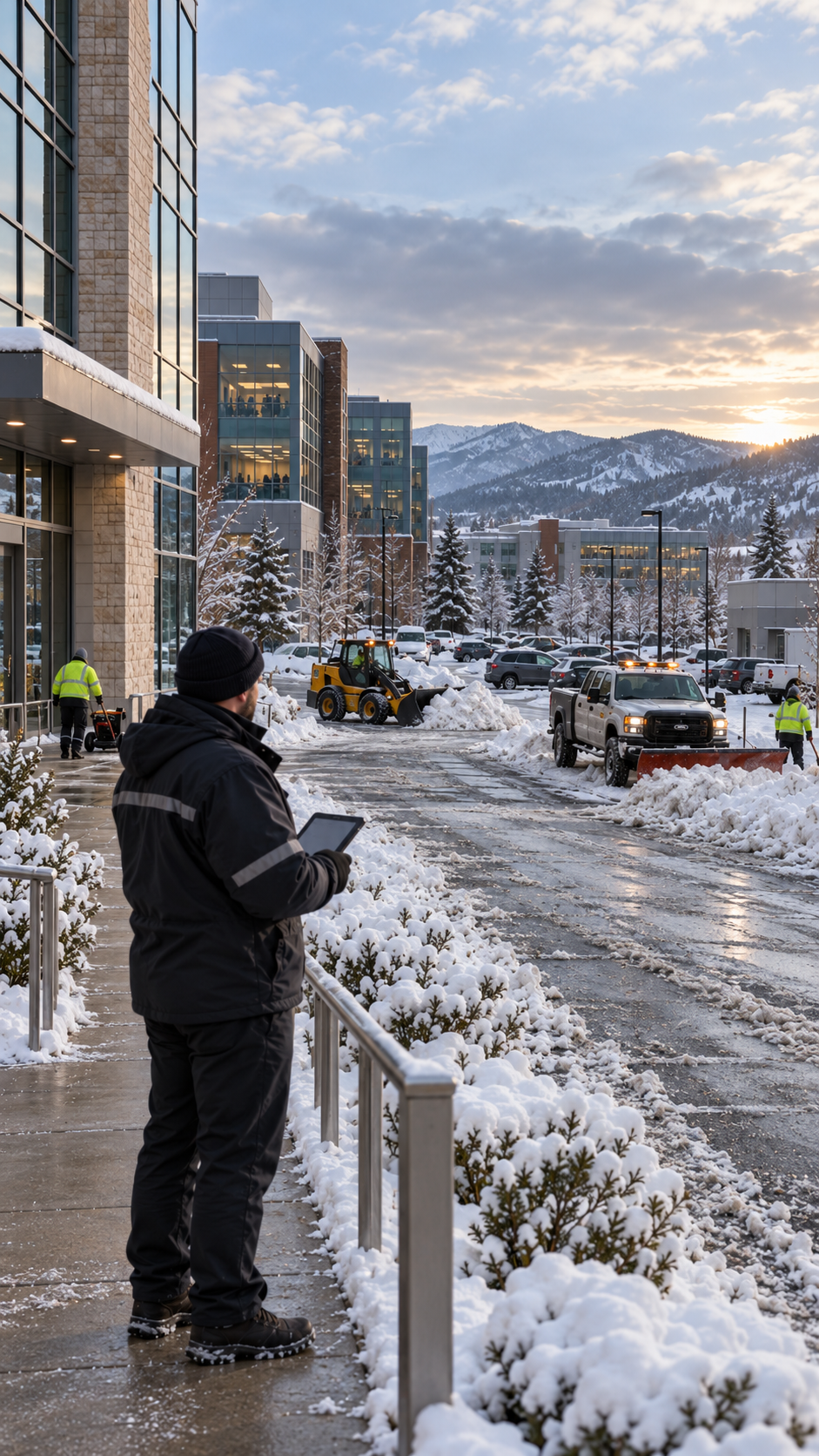
A snow program for a commercial portfolio has to work across different property layouts, markets and weather patterns. The provider needs a clear site plan for each location, while the portfolio team needs one way to set priorities, track service and understand seasonal costs.
The service scope should cover the areas each property depends on, from parking lots and drive lanes to entrances, sidewalks and loading zones. Ice treatment, snow relocation and reporting also need to be defined. If those items are left to local interpretation, the same contract can produce a different service experience at every site.
What a Commercial Snow Program Covers Across Multiple Sites
Commercial snow and ice work can include clearing parking lots, drive lanes, sidewalks, steps, building entrances, accessible routes, loading areas and fire lanes. It may also include applying deicing materials, returning during an active storm, moving snow to an approved storage area, or hauling it off site when piles interfere with access or visibility.
The exact scope depends on the property. A retail site may need customer entrances and parking rows opened before business hours. An office campus may need pedestrian routes and employee parking cleared in stages. A multifamily community may have internal drives, mail areas, sidewalks and emergency access to account for.
List the services and areas by property rather than relying on a general phrase such as “full snow removal.” The provider should know what is included, what is excluded, what triggers another visit and who can approve work outside the agreed scope.
| Property area | What to define in the site plan | Common exception to document |
|---|---|---|
| Parking lots and drive lanes | Areas to clear, priority rows, access routes and expected return visits | Parked vehicles, restricted turning areas or limited snow storage |
| Walkways and entrances | Which routes, steps and entrances are included and when they must be accessible | Tenant access hours, locked gates or areas requiring hand work |
| Loading and service areas | Delivery windows, dock access, refuse areas and turning space | Overnight operations or access shared with another operator |
| Snow storage or removal | Approved pile locations and when relocation or hauling is required | No-pile zones, visibility limits or space that must remain open |
| Ice treatment | Areas, conditions, material approval and how each application is billed | Surface restrictions, landscaping or drainage considerations |
A site walk before the season starts is the easiest way to catch these details. Keep the resulting site plan current when a property changes, access rules shift, or construction changes how equipment can move.
Coordinating Crews in Different Markets and Climates
A portfolio can face different winter conditions at the same time. One market may be dealing with wet snow, another with freezing rain, and a third with a storm that starts several hours later. Route plans, material needs and the number of visits may vary by location.
The provider should explain how local crews are assigned and who coordinates work across markets. Ask whether each site is handled by a local team or subcontractor, how backup capacity is arranged, and what happens when several markets need service at once. A coverage map alone does not explain how crews will be prioritized during a regional storm.
Use a consistent site-plan format so local differences are easy to find. For each property, include its service areas, access instructions, operating hours, priority routes, approved snow-storage locations and local contact. The dispatch team should be able to find those details without relying on one person’s memory.
The portfolio also needs a clear escalation path. Define who receives normal service updates, who handles a missed or incomplete visit, and who can approve additional work when the usual contact is unavailable. When conditions change quickly, property teams should know where to send an urgent update and what response to expect.
Prioritizing Sites: Which Lots Get Cleared First
A provider cannot always service every property at the same time during a widespread storm. Agree on the order of work before the season begins, based on how each site operates and which areas need to stay accessible.
Priorities can be set at both the portfolio and property level. Across the portfolio, a site with continuous public access or critical operations may receive earlier attention. At an individual property, the main entrance, fire lane or accessible route may need to be cleared before secondary parking areas.
| Priority level | Examples of areas or sites | Planning question |
|---|---|---|
| First | Emergency access, main entrances, accessible routes and sites with continuous operations | What must remain usable, and by what point in the service sequence? |
| Next | Primary customer, employee or resident parking; loading areas tied to operating hours | Which areas affect opening, deliveries or daily access? |
| After that | Secondary parking, overflow areas and lower-traffic paths | Can these wait until the priority routes are completed? |
The table is a starting point, not a universal route order. A site’s layout, use and local conditions may change what comes first. The contract or site schedule should give the provider enough direction to make that call consistently, and explain when a property manager needs to be notified about a delay or change in sequence.
Ice Management, Salting and De-Icing as Separate Line Items
Snow clearing and ice management are related, but they are different tasks. Plowing or shoveling removes accumulated snow. Deicing or traction treatment addresses slippery conditions and may require different materials, timing, equipment and return visits.
Keep ice treatment visible in the scope and pricing. Specify the areas covered, the conditions that trigger an application, which materials are approved, whether the provider can apply materials without a separate request, and how materials and repeat applications are billed. If site-specific restrictions apply, record them in the property schedule.
A useful proposal separates the cost of service from the assumptions behind it. The property team should be able to see whether the rate covers labor, materials, application, monitoring and additional visits. Otherwise, two bids that appear similar may include different levels of ice control.
Ask providers to report where treatment was applied and what material was used when that information is available under the service arrangement. It gives the portfolio team a clearer record of what happened at each site and makes later invoice review easier.
Reporting: Knowing Which Sites Were Serviced and When
Portfolio teams need a current view of what has happened across locations during a storm. A message saying “crews are out” does not show which sites were serviced, what work was completed or which locations still need attention.
Agree on a service record for each visit. It should identify the property, service date and time, areas addressed, work performed, materials applied where relevant, and any exception that affected completion. If work is partial, the record should say what remains and whether another visit is planned.
- Property name or site identifier and service date/time
- Service performed and areas covered
- Conditions or access issues that affected the work
- Materials applied, when relevant to the scope or billing
- Completion status, follow-up needed and next expected visit
- Photos or other proof of completion where required by the agreement
For portfolio reporting, group activity by storm, market and property. This helps a regional manager see which locations are complete, which are waiting for service, and where repeated delays or exceptions are occurring. Use the same status terms across providers and markets so the report can be reviewed without translating each vendor’s format.
Agree on the record format before the season starts. Storm updates are easier to review when they arrive in the same structure as the rest of the portfolio’s service history, with the same property identifiers and status terms.
Budgeting for a Variable-Weather Season
Snow budgets are difficult to compare when one portfolio spans markets with different winter conditions. A flat per-property allowance can hide the fact that some sites need more visits, more ice treatment, or snow hauling while others have little activity.
Build the budget from the site list and service assumptions. Review recent seasonal spending by property and market, then separate predictable contract costs from items that change with weather or site conditions. If snowfall histories are available, use them as planning context rather than treating last season as a forecast.
| Budget component | Track separately | Why it helps |
|---|---|---|
| Plowing and sidewalk service | Base, seasonal or per-visit charges by site | Shows the planned cost of routine clearing |
| Ice treatment | Material, application and repeat-service charges | Makes variable treatment costs visible |
| Snow relocation or hauling | Equipment time, haul-off charges and approval rules | Captures costs that may arise when storage space fills |
| Unusual conditions | Overtime, extra mobilization or out-of-scope work | Keeps exceptions from disappearing inside a general allowance |
| Seasonal variance | Budget, actual spend and service volume by market | Improves next year’s forecast and vendor comparison |
Ask each provider to price the same scope and show which items can change after a certain amount of work, material use or weather activity. Set approval limits for extra services, and decide how the property team will handle urgent work when an approval contact is unavailable.
After the season, compare actual cost with service volume by market and site. A higher total may reflect a more active winter, a different scope, or additional applications. The breakdown helps the team adjust next year’s assumptions without treating every cost increase as a pricing problem.
What to Require from a Multi-Site Snow Provider
Before selecting a provider, ask for a plan that can be reviewed against the full property list. A credible proposal should show how the company expects to handle the work locally and how it will report performance to the portfolio team.
- Written confirmation of coverage by property, market and service category
- A site plan for each location, including priorities, access and snow storage
- How local crews, subcontractors and backup capacity are coordinated
- Trigger and dispatch rules for plowing, ice treatment and repeat visits
- Pricing for materials, hauling, additional service and unusual conditions
- A consistent storm reporting format with completion status and exceptions
- Named contacts and an escalation process for missed or incomplete work
- Current insurance information and contract terms reviewed by the appropriate legal or procurement team
For a provider-selection checklist, see HiredHelpr’s guide to choosing a commercial snow removal company for a multi-site portfolio. For broader portfolio operations, see how property teams maintain service consistency across multiple markets.
A Portfolio Snow Program Depends on Its Site Plans
Shared operating rules keep a portfolio snow program consistent, but the site plans decide how it performs during a storm. Keep each property’s areas, priorities, access details and reporting expectations current before the season starts, and review them again after the first event.
HiredHelpr is a tech-enabled national service provider for multi-property operators, managing recurring grounds care, seasonal preparation and responsive maintenance through a vetted vendor network. The list above can be used as the HiredHelpr Multi-Site Snow Program Checklist when reviewing proposals from snow and ice providers.
Contact HiredHelpr to discuss year-round maintenance across your portfolio.
Frequently Asked Questions
How does commercial snow removal change across a multi-site portfolio?
The work has to account for different site layouts, local weather, operating schedules and crew capacity. A portfolio plan sets common dispatch and reporting rules, while each property’s site schedule records its priority areas, access details and exceptions.
Should parking lots and sidewalks be included in the same snow removal scope?
They can be included in one agreement, but list them as separate service areas. Sidewalks, entrances and accessible routes may have different timing, equipment and ice-treatment requirements than parking lots.
Should salting and de-icing be included in the snow removal price?
Specify them separately, even if the provider bundles the charges. State the approved materials, application triggers, covered areas, and how repeat applications or material use affect the bill.
What should a snow removal report include for each property?
At minimum, record the site, service date and time, work and areas completed, materials applied when relevant, and any exception or follow-up visit. Use consistent status terms across locations so teams can see portfolio-wide progress during a storm.